Table of Contents
Artificial Intelligence has existed for years, but things changed when artificial intelligence systems started making things for humans.
Modern artificial intelligence can not only analyse information and predict what might happen next, but it can also write an email, make a picture, generate music, summarise a document, build computer code, or even help brainstorm ideas.
And here is where Generative AI comes in.
But with all the hype around technologies like picture generators and AI helpers, one simple point often gets overlooked:
What is the main goal of generative AI?
The easiest answer is:
The primary purpose of Generative AI is to generate new content by using the patterns and information gained from the existing data.
Such information may include text, photos, music, video, code, and more.
But Generative AI is about more than just “making things.”
But its actual power is its capacity to let people create, explore ideas, solve issues, automate tedious tasks, and interact with technology in a more natural way.
Let’s find out what Generative AI actually is, why it is being adopted so rapidly, what it can build, how these tools function, and how we may use them responsibly.
What is generative AI?
Generative AI is a branch of Artificial Intelligence designed to produce new content.
Traditional AI is often built to recognise patterns, classify information, make predictions, or help make decisions.
Generative AI takes a different approach.
Instead of only answering:
“What does this data tell us?”
it can also help answer:
“What can we create from what we have learned?”
For example, a traditional AI system might identify whether an image contains a cat.
A Generative AI system could create a completely new image of a cat sitting beside a window.
Similarly, a traditional system might analyse existing text, while a Generative AI system can use what it has learned about language to produce a new paragraph, story or explanation.
This ability to generate new content is what gives Generative AI its name.
What Is the Main Goal of Generative AI?
At its core, the main goal of Generative AI is to generate useful new content from patterns learned from existing data.
But its purpose goes beyond content creation.
Generative AI is increasingly being used to help people:
- Generate ideas
- Write and rewrite content
- Create images
- Produce audio
- Generate computer code
- Summarise large amounts of information
- Translate or transform content
- Explore different possibilities
- Automate repetitive creative tasks
- Assist with research and problem-solving
Think of it as a technology that can turn an instruction or prompt into an output.
You provide the direction.
The AI generates a response.
You review it.
Then you can refine it further.
That interaction is one of the biggest changes Generative AI has brought to everyday technology.
How is generative AI different from traditional AI?
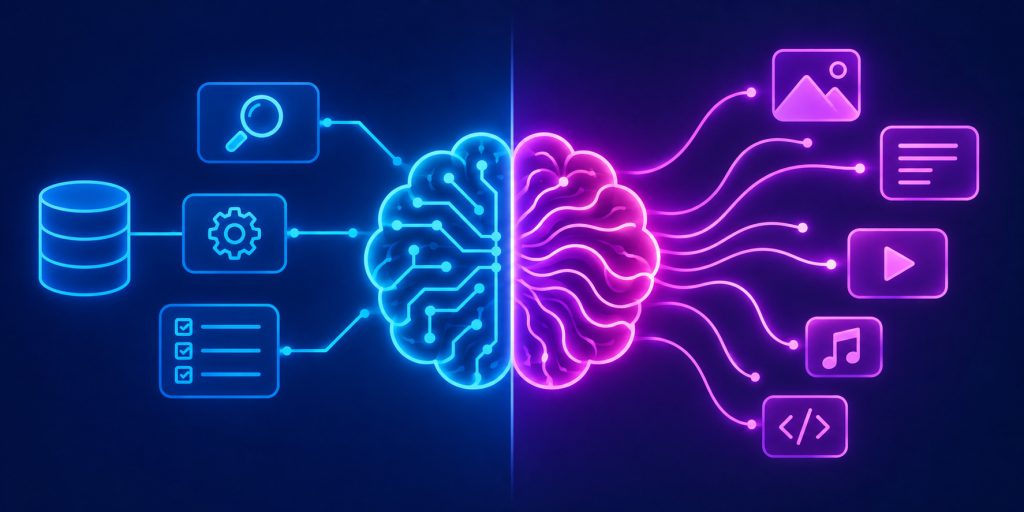
This is where many people get confused.
Artificial Intelligence is a broad field. Generative AI is a component of it.
Specific objectives are frequently the focus of conventional AI systems, including:
- Recognising faces
- Detecting fraud
- Recommending products
- Predicting demand
- Identifying objects
- Classifying information
- Detecting unusual behaviour
Generative AI can also analyse patterns, but its distinguishing feature is its ability to produce new outputs.
For example:
| Traditional AI | Generative AI |
| Identifies an object in an image | Creates a new image |
| Predicts a result | Generates possible responses |
| Classifies text | Writes new text |
| Recognises speech | Generates speech or audio |
| Detects patterns | Uses learned patterns to create content |
| Recommends information | Can generate an explanation or response |
The two are not opposites.
Generative AI is built using many of the same underlying ideas that have powered AI and machine learning for years.
The difference is what the system is designed to produce.
How does generative AI work?
You do not need to understand complicated mathematics to understand the basic idea.
Imagine giving an AI system access to a huge amount of information.
During training, the system learns patterns and relationships within that information.
For a language model, this may involve learning relationships between words, sentences, and concepts.
For an image model, it may learn relationships between visual elements, shapes, styles, and descriptions.
When you give the system a prompt, it uses what it has learned to generate an output that fits the request.
For example:
Prompt:
“Write a short story about a robot helping a child learn science.”
The AI doesn’t simply search the internet for an existing story and paste it back.
Instead, the model generates a new response based on patterns it learned during training.
This is why the same prompt can produce different answers at different times or in different systems.
What can generative AI create?
One of the most interesting things about Generative AI is how many types of content it can produce.
Let’s look at the major categories.
1. Text Generation
Text-based Generative AI is probably the form most people encounter first.
You can ask an AI tool to:
- Write an article
- Explain a difficult concept
- Create a story
- Summarise information
- Draft an email
- Generate questions
- Create lesson ideas
- Rewrite content
- Translate text
- Brainstorm ideas
For students, it can help explain a difficult topic in simpler language.
For teachers, it can help brainstorm classroom activities.
For businesses, it can assist with drafts, reports, and communication.
But there is an important rule:
AI-generated text should not automatically be treated as correct.
It should be reviewed, checked, and improved by a human.
2. Image Generation
Generative AI can also create images from written descriptions.
For example, you could describe:
“A futuristic classroom where students are building robots.”
An image-generation system can interpret the description and create a visual based on it.
This can be useful for:
- Education
- Advertising
- Graphic design
- Presentations
- Concept development
- Storytelling
- Product ideas
- Creative experimentation
Image generation has also changed the creative process.
Previously, creating a visual concept might require photography, illustration, or specialised design skills.
Now, people can describe an idea and quickly explore several visual possibilities.
That does not eliminate the need for human creativity.
In many cases, it simply gives people a faster way to experiment with their creativity.
3. Audio Generation
Generative AI can also work with sound and audio.
Depending on the tool, it can generate or transform:
- Speech
- Voice
- Music
- Sound effects
- Audio narration
For example, someone creating an educational video could use AI-generated narration.
A musician could experiment with different musical ideas.
A content creator could generate audio for a prototype.
However, audio generation also brings important questions around consent, copyright, and the misuse of someone’s voice.
Creating a realistic voice that sounds like a real person without permission can create serious ethical and legal concerns.
So the ability to generate something does not automatically mean we should generate it.
4. Video Generation
Generative AI is also moving rapidly into video.
A user can provide text, images, or other instructions, and AI systems can generate or modify video content.
Possible uses include:
- Educational videos
- Product demonstrations
- Marketing content
- Animation
- Storytelling
- Visual effects
- Concept videos
As these systems improve, the difference between real and AI-generated media can become increasingly difficult to identify.
That makes media literacy more important than ever.
5. Code Generation
Generative AI can also generate computer code.
A developer can describe what they want to build, and an AI tool can suggest code, explain an error, or help modify an existing program.
For example:
“Create a simple Python program that calculates the average of five numbers.”
The AI can generate a possible solution.
This can make programming more accessible, particularly for beginners.
But again, generated code needs to be tested.
AI can produce code that looks correct but contains errors, security problems, or inefficient approaches.
The human still needs to understand what the code is doing.
Why do we need generative AI?
The rapid adoption of Generative AI is not happening simply because the technology is interesting.
It solves several practical problems.
It saves time
Tasks that once required hours of drafting or repetitive work can sometimes be completed much faster with AI assistance.
A teacher can create a first draft of quiz questions.
A professional can create an initial report structure.
A designer can generate early concepts.
A developer can get help with repetitive code.
The important word here is assistance.
AI can reduce the time spent getting started, but human review remains important.
It Makes Ideas Easier to Explore
Sometimes the biggest barrier to creativity is not a lack of ideas.
It is not knowing where to begin.
Generative AI can help people move from:
“I have an idea.”
to:
“Here are five possible ways I could develop it.”
This can be especially useful during brainstorming.
It Makes Technology More Natural
Traditional software often requires users to learn specific commands, menus, or workflows.
Generative AI allows people to interact using everyday language.
Instead of learning a complicated interface, a person can explain what they want.
That makes technology more accessible to people who may not have advanced technical skills.
It Can Personalise Experiences
Generative AI can adapt content based on a user’s request.
For example, the same topic can be explained:
- For a beginner
- For a school student
- In simpler language
- With examples
- As a story
- As a step-by-step explanation
This creates opportunities for more personalised learning and communication.
What Are the Benefits of Generative AI?
Generative AI can offer several advantages when used thoughtfully.
Faster Content Creation
AI can help produce first drafts quickly.
Increased Productivity
People can spend less time on repetitive tasks and more time on higher-value work.
Better Brainstorming
AI can suggest alternative ideas and approaches.
Personalised Learning
Students can ask for explanations suited to their level.
Accessibility
AI can help transform information into different formats.
Creative Exploration
People can experiment with text, images, audio and other media without needing specialised skills for every stage.
Support for Professionals
AI can assist writers, teachers, programmers, designers, researchers and many other professionals.
But these benefits depend heavily on how the technology is used.
What Are Generative AI Tools?
Generative AI tools are applications that use generative models to produce or transform content.
Different tools specialise in different types of output.
Text Tools
These can help with:
- Writing
- Summarising
- Brainstorming
- Research assistance
- Question generation
- Explanations
- Translation
Examples include conversational AI assistants and large language model-based tools.
Image Tools
These generate images from prompts or modify existing visuals.
They can be useful for:
- Illustrations
- Concept art
- Posters
- Educational visuals
- Creative projects
Audio Tools
These can generate speech, music, or other audio content.
Video Tools
These can create or transform video using text, images, or other inputs.
Coding Tools
These help users generate, explain, debug, or improve computer code.
The important thing is not to choose a tool simply because it is popular.
Choose the tool based on:
What are you trying to accomplish?
How Do You Use Generative AI?
Using Generative AI usually begins with a prompt.
A prompt is simply the instruction or request you give to an AI system.
For example:
“Explain photosynthesis to a Class 6 student using a simple real-life example.”
Compare that with:
“Explain photosynthesis.”
The second prompt is much less specific.
The first tells the AI:
- The topic
- The student’s level
- The preferred style
- The type of explanation
This usually makes it easier to get a useful response.
A Simple Formula for Better Prompts
You don’t need complicated prompt engineering to begin.
Try giving the AI four things:
Role + Task + Context + Output Format
For example:
“Act as a science teacher. Explain the water cycle to a Class 6 student. Use simple language and one everyday example. Present the answer in five short points.”
This is much clearer than:
“Tell me about the water cycle.”
The more clearly you communicate your goal, the easier it becomes to guide the AI.
Don’t Stop at the First Answer
One of the biggest mistakes beginners make is treating the first AI response as the final answer.
Generative AI works best as an interaction.
You can say: “Make it simpler.”
Then: “Give me an example.”
Then: “Turn this into five questions.”
Then: “Now explain question 3.”
You are essentially having a conversation with the system to improve the result.
This is one reason Generative AI feels different from traditional search.
But Can We Trust Generative AI?
Not blindly.
This is one of the most important things anyone using Generative AI should understand.
AI can produce information that sounds confident but is incorrect.
These errors are sometimes called hallucinations.
The problem is not always obvious because the response may look polished and convincing.
That is why users should:
- Check important facts
- Compare information with reliable sources
- Avoid sharing sensitive personal information
- Review AI-generated content
- Question unusual claims
- Use human judgement
The better the output looks, the easier it can be to forget that it was generated by a machine.
So remember:
Fluent does not always mean factual.
What Are the Risks of Generative AI?
Like any powerful technology, Generative AI comes with both opportunities and risks.
Inaccurate Information
AI can make mistakes or provide outdated information.
Bias
AI systems learn from data, and data can contain biases.
Privacy
Users should be careful about entering confidential, private, or sensitive information into AI systems.
Copyright and Ownership
AI-generated content raises complicated questions around the use of training data, ownership and creative rights.
Deepfakes and Misleading Content
Generated images, audio and video can be used to create convincing but false content.
Overdependence
If people use AI for every task, they may stop developing their own reasoning and creative abilities.
This is particularly important for students.
AI should help a student learn, not replace the student’s learning.
Generative AI in Education
Education is one area where Generative AI can have a significant impact.
A student struggling with a topic can ask for another explanation.
A teacher can brainstorm classroom activities.
A school can create different versions of practice questions.
Students can explore ideas through conversation.
But there is a line that needs to be protected.
If a student asks AI to complete an assignment and submits the response without understanding it, the technology has not supported learning.
It has replaced learning.
The better approach is:
Ask AI → Understand → Question → Verify → Improve → Create your own answer
That process develops AI literacy rather than AI dependence.
Generative AI Is a Tool, Not a Replacement for Human Thinking
This may be the most important idea to remember.
Generative AI can write.
It can draw.
It can compose.
It can summarise.
It can code.
It can brainstorm.
But humans still decide:
What should be created?
Why should it be created?
Is it accurate?
Is it ethical?
Is it useful?
Should we trust it?
That human layer remains essential.
Generative AI becomes much more powerful when human creativity and machine capabilities work together.
What Is the Future of Generative AI?
Generative AI is likely to become increasingly integrated into everyday tools.
Instead of opening a separate AI application, people may simply find AI capabilities built into the software they already use.
AI may help us:
- Write documents
- Analyse information
- Create presentations
- Design products
- Learn new skills
- Develop software
- Communicate across languages
- Create media
- Automate routine tasks
We are also likely to see AI become more multimodal, meaning systems can work across text, images, audio, video and other types of information.
The technology will continue changing.
That is why learning how to use one particular AI tool is less important than learning how to work intelligently with AI itself.
The Right Way to Think About Generative AI
Generative AI should not be seen as:
“A machine that does everything for us.”
A better way to see it is:
“A tool that can help us create, explore, and work more effectively.”
The difference is important.
If we ask AI to do everything, we risk becoming dependent on it.
If we learn how to collaborate with it, we can use its strengths while continuing to apply our own judgement.
The future will probably not belong to people who simply know how to use AI.
It will belong to people who know when to use it, how to guide it, how to question it, and when not to use it.
Conclusion
So, what is the main goal of generative AI?
At the simplest level, it is to generate new content from patterns learned from existing information.
But its larger purpose is much more interesting.
Generative AI can help people turn ideas into drafts, questions into explanations, descriptions into images and instructions into working outputs.
It can save time, support creativity, make technology easier to interact with and open new possibilities across education, business, research, design and everyday life.
At the same time, it comes with responsibilities.
AI-generated information can be wrong. Content can be biased. Privacy can be compromised. Generated media can be misused. And people can become too dependent on automated answers.
That is why the future of Generative AI should not be about AI replacing human thinking.
It should be about humans thinking better with AI.
The most valuable skill, therefore, is not simply knowing how to generate something.
It is knowing what to ask, why to ask it, how to evaluate the answer, and what to do with it next.
And that is where the real power of Generative AI begins.
AI solutions by Shikshak Solutions: https://shikshaksolutions.com/ai-lab