Table of Contents
Students are learning, communicating, working, and solving issues in new ways. Today, a classroom is no longer training youngsters for exams or for a range of professions. Students are growing up in a world influenced by artificial intelligence, automation, digital technology, worldwide collaboration, and constant change.
That’s why education must go beyond academic knowledge.
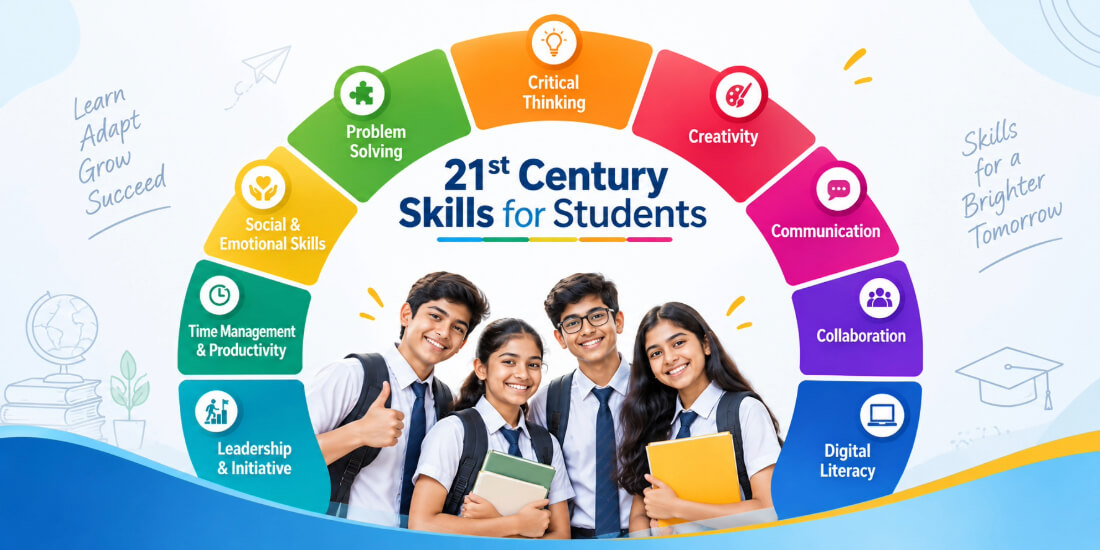
Students need to think, communicate, cooperate, create, adapt and apply information efficiently. These are often referred to as 21st-century skills for pupils.
For schools, teachers and parents, acquiring these abilities is becoming an important aspect of preparing children for higher education, careers and daily life. These capabilities are grouped under learning, literacy and life skills within CBSE’s own 21st Century Skills framework that is built around the well-known 4Cs, namely critical thinking, creativity, collaboration and communication.
What Are 21st Century Skills for Students?
21st century skills are the information, talents, attitudes, and behaviors that equip students to succeed in academic, professional, and real-world circumstances.
These are not abilities like a subject that you can finish after a certain chapter or test; rather, they are developed with ongoing practice and experience.
For example, a learner may learn the formula to solve a mathematical problem. But finding the correct problem, analyzing the facts available, discussing alternative solutions with others, and then creating a practical answer takes a distinct set of skills.
That’s where the 21st-century talents come in.
These skills assist students in shifting from knowing something to using what they know.
Why Are 21st Century Skills Important for Students?
It’s hard to know what future pupils are studying for. New technologies are transforming how organizations and industries operate and how consumers access information.
Students therefore require more than good academic success.
They should know how to:
- Use your own judgment and make the right decisions
- Work on problems you don’t know.
- Communicate ideas plainly
- Work with other people
- Create fresh concepts
- Use technology responsibly
- Assess information and find dependable sources
- Adapt to Emerging Circumstances
- Be proactive.
- Control time and responsibility
Training that promotes those skills can help students become more confident and autonomous learners.
CBSE has emphasized imparting skills so that students are equipped to confront real-life issues in an information and technology-driven world.
The 4 Cs of 21st Century Skills
Among the most well-known talents for students are the 4 Cs of 21st century skills:
Thinking Critically
Inventiveness
Cooperation
Communications.
These four skills are very much interrelated. A student can have a creative idea, but the ability to communicate it effectively, work with a team, and critically assess if it can genuinely address an issue is as vital.
1. Think Critically
Critical thinking is the ability to look at information, ask questions, analyze situations, and make logical conclusions.
Students engage in critical thinking when they:
- Consider multiple answers to a problem
- Question why things happen
- Check out the facts before you believe them
- Discover patterns
- Challenge assumptions
- Decide on Facts
For example, one who thinks critically will not just take an answer from an internet platform or AI tool, but will ask questions such as “Is this information correct, and is it supported by good evidence?”
Critical thinking, therefore, allows pupils to become active learners rather than passive receivers of knowledge.
2. Creativity
Creativity does not mean sketching, painting, or any kind of art.
Students think creatively when they devise fresh ways of solving an issue, come up with novel ideas, and view familiar situations in new ways.
A classroom exercise can inspire creativity by giving pupils the opportunity to:
- Develop their own solutions
- Build prototypes and models
- Experiment with different methods
- Write articles, presentations or digital content
- Invention development
- Improve a current process or product
Project-based learning, STEM activities, robotics and design thinking can offer hands-on chances for students to bring ideas to life.
3. Collaborating
Very few problems in the real world are addressed by one individual working in total isolation.
Working together also helps kids to work with others who have diverse ideas, strengths, and viewpoints.
Students build collaborative abilities through participation in:
- Group projects
- Group Challenges
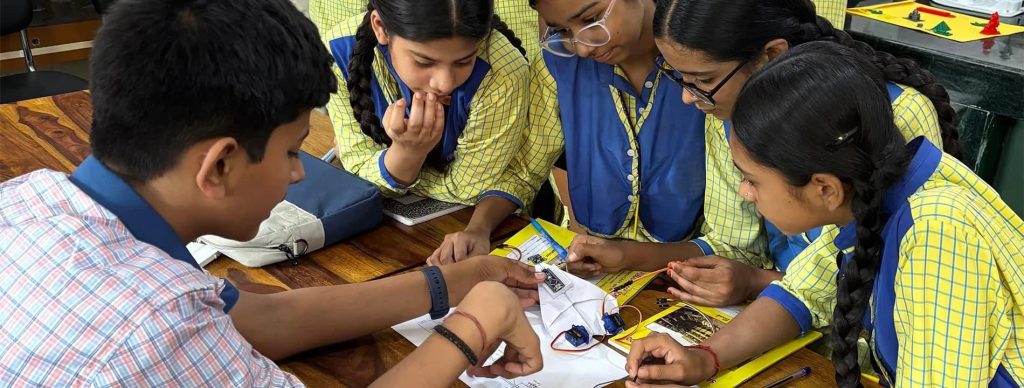
- STEM and robotics activities
- Discussions in class
- Research projects
- Learning from colleagues
- Activities to solve problems
To work together effectively, it’s not enough to just break a project down into distinct parts. Students must listen to each other, share responsibilities, work through conflicts, and strive toward a common goal.
These experiences can ready children for workplaces where cooperation is an integral part of learning and functioning.
4. Communicating
A good idea has little value if the student cannot convey it well.
Communication skills assist pupils to communicate concepts, listen attentively, and convey information effectively.
Communication is composed of:
- Talking
- Composed
- Listening
- Introducing
- Questions
- Ideas explained
Respectful communication with others
Schools can improve communication abilities by means of presentations, debates, storytelling, group discussions, demonstrations, and project presentations.
As students repeatedly explain what they learned and why they made certain choices, they also become more confident in speaking their minds.
Digital Literacy: An Essential Skill for Today’s Students
Technology is now so integrated into education, communication, and our daily lives. Thus, online literacy is a crucial aspect of 21st century learning.
Digital proficiency is more than simply learning how to use a computer or smartphone.
Students also need to learn to use electronic devices safely, analyze online content, protect their privacy, and communicate responsibly in digital settings.
The important areas include:
- Technology fluency
- Information literacy
- Media literacy
- Cyber Security
- Responsible Use of Technology
- Electronic communication
- Digital content understanding
Since students have access to a huge amount of content online, the ability to identify genuine information from misleading or inaccurate information is extremely crucial. The framework of 21st century skills often includes information, media, and technology literacy along with the 4Cs.
Problem-Solving Skills
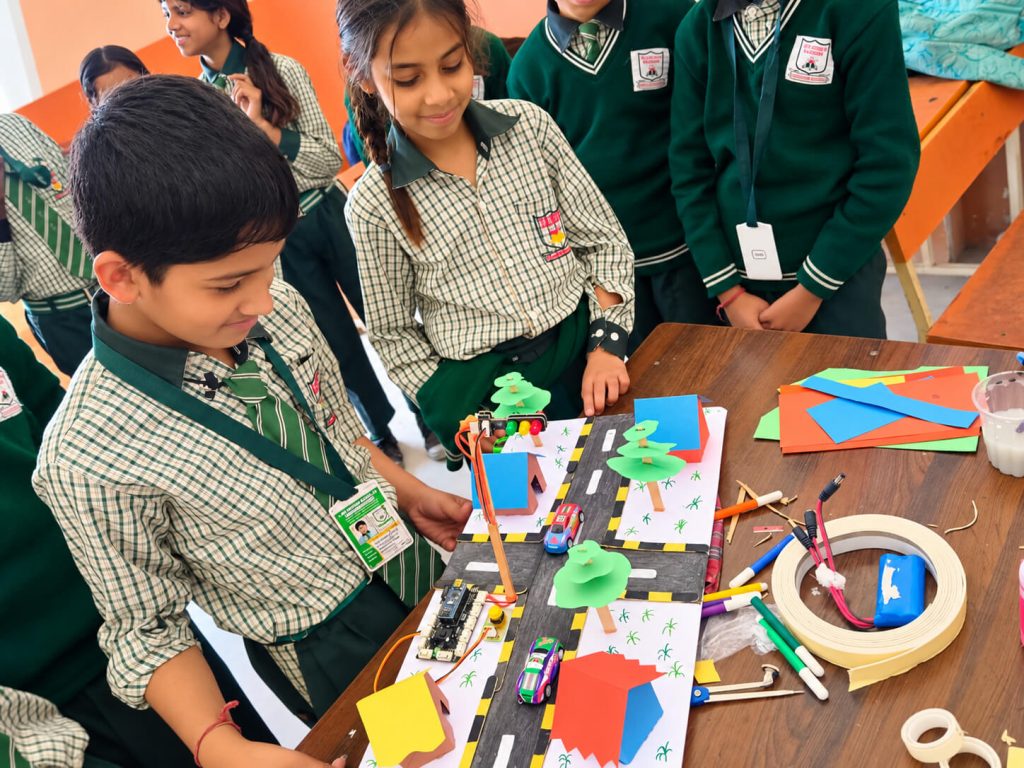
Problem-solving is very directly tied to critical thinking and creativity.
Students face problems every day. These may be academic problems, group problems, decision-making problems, or regular life problems.
Students can be prompted to: instead of immediately seeking an answer
Identify → Analyze → Generate → Test → Refine
For instance, students may find that a robot they are constructing for a simple robotic model does not move as anticipated. Instead of getting the solution straight away, they might explore the links, try other ideas, and change their design.
It is more than a functioning model. The student learns the procedure of solving problems.
Adaptability and Flexibility
Change is a hallmark of the modern world.
Students will ultimately be working in professions and with technologies that are far removed from what exists now. Adaptability is more crucial than ever.
A flexible learner can:
- Respond to the unanticipated
- Find fresh ways
- Comments are allowed
- If one way doesn’t work, try another way
- Learn from mistakes
- Adjust to new environments
Flexibility is another important learning. Not every first try will be successful, and that’s part of learning.
The more we enable students to try, fail, and revise in our classrooms, the more readily they adapt.
Leadership and Initiative
Leadership isn’t necessarily the person in power.
For kids, leadership could be just taking charge of a task, helping out teammates, organizing a project, or coming up with a good idea.
Initiative is the readiness to start something instead of always waiting for instructions.
Students may assist them in developing these qualities by providing them with opportunities to:
- Organize group activities
- Manage Projects
- Organize activities
- Share their thoughts.
- Take decisions
- Start projects on their own
- Own their learning
Eventually, these experiences build confidence and a sense of responsibility.
Time Management and Productivity
Students have to juggle courses, homework, projects, activities, examinations, and personal duties.
They can learn to be more organized and autonomous by learning to manage time.
Simple habits like making a list of activities, assigning priorities, breaking a major assignment down into smaller assignments, and meeting deadlines can introduce kids to good time management.
Productivity is not about keeping pupils occupied all the time. It’s about teaching them to make the most use of their time and resources.
Social and Emotional Skills
Academic accomplishment is just one aspect of student development.
Students also need to know themselves and have good interactions with people around them. Empathy, active listening, responsible decision-making, and polite communication can impact how students handle relationships and obstacles.
These skills can enable youngsters to:
- Understand various views
- Resolve conflicts
- Work with others in a courteous manner
- Develop good relationships
- React to criticisms correctly
- Express compassion
- Know thyself
So a future-ready student needs not only intellectual talents but also good interpersonal skills.
How Can Schools Develop 21st Century Skills?
21st century skills cannot be developed effectively through memorisation alone.
Students need opportunities to apply, experiment, discuss, create, and reflect.
Schools can integrate these skills into everyday learning through:
Project-Based Learning
Projects let students explore a question or real-world problem and come up with a solution. They naturally conduct research, communicate, collaborate, be creative, and solve problems along the way.
STEM and Robotics Activities
Hands-on STEM activities may make abstract concepts into concrete experiences. When students design, develop, test, and enhance a project, they learn via action.
Design Thinking
Design thinking asks students to learn about an issue, consider various solutions, make prototypes, test them, and refine their thinking.
Group Activities
Team-based exercises allow students to practise communication, collaboration, leadership and dispute resolution.
Presentations and Discussions
Letting pupils clarify their thoughts helps build communication and confidence.
Digital Learning
Responsible use of digital resources can aid students in developing technology literacy, information literacy and research abilities.
Real-World Problem Solving
Linking classroom principles to real-world circumstances makes learning more meaningful. Students can explore issues connected to sustainability, transportation, healthcare, environment, energy, or their own communities.
The Role of Teachers in Developing 21st Century Skills
Teachers are at the heart of constructing the classrooms that allow these talents to flourish.
Teachers can teach kids to ask better questions instead of giving them all the answers.
An instructor might ask:
What do you think?
What do you suppose this is?
Can you find a different solution?
What if we did the reverse?
How could you enhance your idea?
Such questions turn the classroom from a place of knowledge delivery to a place of student thinking and participation.
Teachers need opportunities to understand and demonstrate these skills as well. Research and education frameworks emphasize the necessity of providing educators with the support and professional development needed to incorporate 21st century skills into classroom learning.
How STEM Education Can Support 21st Century Skills
STEM education creates a natural setting for the development of many of these talents, as it combines knowledge with practical application.
Consider a student who is working on a robotics project.
The student may need to:
- Learn how the components function
- Find a problem
- Design a solution
- Make a prototype.
- Test the design
- Mistakes find
- Work with team members
- Describe the finished project
- Upgrade the solution
In this way, one activity can incorporate critical thinking, creativity, teamwork, communication, problem solving, and technology literacy.
That’s why hands-on learning may be so vital to the development of future-ready kids.
21st Century Skills and Future-Ready Education
Future-ready isn’t about forecasting exactly what profession a student will do in the future.
It’s about equipping students to learn, adapt, and solve challenges throughout their lives.
Technology will keep on evolving. Jobs will change. New industries will spring up. The tools children will use tomorrow may not be the same tools they use today.
But the ability to think critically, to communicate clearly, to work well with others, to create new solutions and to adapt to change will continue to matter.
This broader approach is also in tune with the trajectory of skill-based education in India. CBSE’s existing academic resources continue to focus on skill development, including compulsory skill education for Classes VI-VIII from the 2026-27 session.
21st Century Skills for Students: A Quick Checklist
Schools and parents can use the following checklist to understand the areas students should gradually develop:
| Skill | What It Helps Students Do |
| Critical Thinking | Analyse information and make informed decisions |
| Creativity | Generate original ideas and solutions |
| Collaboration | Work effectively with others |
| Communication | Express and present ideas clearly |
| Problem Solving | Find practical solutions to challenges |
| Information Literacy | Evaluate and use information effectively |
| Media Literacy | Understand and assess media content |
| Technology Literacy | Use technology confidently and responsibly |
| Adaptability | Respond positively to change |
| Leadership | Take responsibility and guide others |
| Initiative | Start tasks and act independently |
| Time Management | Organise priorities and meet goals |
| Social Skills | Build positive relationships |
| Self-Direction | Take ownership of learning |
Frequently Asked Questions About 21st Century Skills
What are the most important 21st century skills for students?
The most commonly emphasized skills include critical thinking, creativity, collaboration and communication, along with problem-solving, digital literacy, adaptability, leadership, initiative, and social skills.
Why are 21st century skills important for students?
They help students apply their academic knowledge to real-world situations and prepare them to handle changing educational, professional, and social environments.
What are the 4 Cs of 21st-century skills?
The 4 Cs are Critical Thinking, Creativity, Collaboration, and Communication.
How can schools teach 21st-century skills?
Schools can integrate them through project-based learning, STEM activities, robotics, design thinking, group projects, classroom discussions, presentations, research activities, and real-world problem-solving.
Can 21st-century skills be developed outside the classroom?
Yes. Sports, hobbies, teamwork, creative activities, household responsibilities, community activities, and independent projects can all provide opportunities to practise skills such as leadership, communication, collaboration, creativity, and problem-solving.
Are 21st century skills only useful for future careers?
No. These skills are useful in everyday life as well. Students use communication, decision-making, collaboration, adaptability, and problem-solving in school, relationships, communities, and eventually the workplace.
Conclusion
Education is not about helping kids remember. It is to enable people to apply knowledge effectively, think independently, and respond with confidence to the world around them.
That’s the actual importance of 21st century talents for pupils.
They question and analyze through critical thinking. Creativity is their ability to create possibilities. Teamwork helps them to work with others. They express their opinions through communication. Digital proficiency means they are able to navigate an information-rich world. Adaptability means they can adapt to change:
As these skills become embedded in everyday learning, kids are better equipped to be confident learners, creative problem solvers, and future-ready people.
So the focus for schools must shift from asking merely “What should students learn?” to also asking:
What can students do with what they’ve learned?
That change can make learning more practical, meaningful, and relevant for the future.