There are questions youngsters ask that teachers never forget.
Not that the questions are so very difficult, but because they reveal something far more important: the way a young mind is beginning to see the world. A toddler watches a robot moving, and questions how it knows where to go. Another wonders how come a light automatically comes on when people walk into a room. Another looks at a broken piece and almost casually asks, “Can we make it better?”
They’re little moments in a normal school day. But many of the world’s greatest ideas have always started with something similarly simple: curiosity.
And there is typically a teacher standing on the other side of that issue.
A teacher can answer the question and go to the following lesson. Or they can stop, grin, and remark, “That’s a good question. What do you think?”
That second response can redirect learning.
It tells a child that questions are precious. It tells children that they don’t always have to wait for someone else to answer. It offers kids the freedom to explore, experiment, and even to get things wrong along the way. And most of all, it tells kids their ideas count.
This is what we call the teacher effect, the tremendous impact a teacher can have in translating a child’s inherent curiosity into confidence, creativity, and ultimately the ability to innovate.
The Teachers Who Make Us Look at Things Differently
We all recall a teacher who brought a subject alive.
Maybe it was the teacher who made science more than just a bunch of words and illustrations. Maybe it was the math teacher who showed us that numbers could genuinely explain the world to us. Perhaps it was the teacher who convinced a reluctant student to enter a competition. Or the one who noticed an unfinished project and advised, “Don’t give up yet.”
It’s easy to downplay these moments.
As a teacher, you don’t always get to see the result of your influence. That child they motivate today may become an engineer many years later. They may be feeding the curiosity of a student who may one day work in artificial intelligence, robotics, medicine, research, or technology. They may take the quiet student they encourage to speak and make him a confident leader.
The teacher will never know where that influence led precisely.
Yet it was there.
Education has always been about knowledge, but excellent education has never been about knowledge. It’s about helping children gain the confidence to utilise what they know, challenge what they don’t understand, and imagine what could be possible.
This is extremely crucial today.
Kids are growing up in a world of Artificial Intelligence, automation, robotics, coding, smart devices and fast-changing technology. They’ve got the knowledge at their fingertips. In seconds, they can find an answer to practically any factual enquiry. But knowing how to find an answer is very different from knowing how to identify a problem worth tackling.
That is where teachers continue to make an amazing difference.
From Curiosity to Creation
It is curiosity that makes a child question why an automatic light goes on. A child who asks how to make one is learning to think like a creative person.
But what’s important is the meaningful learning that happens in between those two instances.
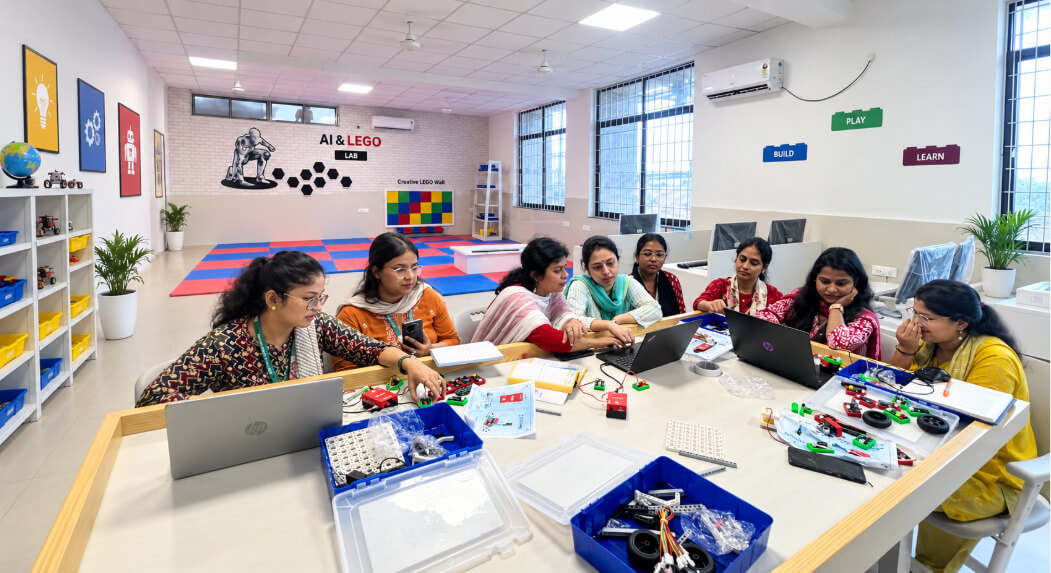
It could be as basic as a school activity. Students are provided with certain electronic parts and asked to create an LED light. They hook up the wires, test the circuit and find something isn’t working. They verify their links, make an adjustment, and try again. When the light eventually comes on, it is nothing compared to reading about an electrical circuit in a textbook.
They have found something for themselves.
The same idea applies when students are working with sensors, motors, coding, robotics or Artificial Intelligence. A student can make concepts that may otherwise seem abstract become real, by building a small system, programming a robot or using a sensor to address a practical problem.
This is the power of experiential and hands-on learning. Students do not only get handed information; they interact with it.
And the instructor has such a crucial role to play in this process.
The teacher doesn’t need to have all the answers ready. In fact, often the most impactful thing a teacher can do is step back and let pupils research. Instead of immediately describing why anything happened, the teacher can ask, “What did you notice?”, or “What could we change?”, or “Why do you think it behaved that way?”.
That kind of inquiry makes kids ponder.
They build the behaviours that form the foundation of Computational Thinking: decomposing an issue, spotting patterns, recognising sequences, weighing up options and working through a solution step by step. They also develop creativity, critical thinking and problem-solving – qualities that are increasingly vital in a world where technology is evolving at a quicker pace than ever before.
Technology will change.
The tools can alter.
But the ability to think, question and create will always count.
When Failure Becomes Part of Learning
There is another important lesson teachers give their students, often without saying it directly: it is perfectly acceptable not to get it right the first time.
Anyone who has worked with technology knows this. A program does not behave as expected. A circuit does not work. A robot moves in the wrong direction. A design that looked perfect on paper fails when it becomes a physical model.
For a child, that first failure can be frustrating.
But imagine a teacher responding not with “That’s wrong,” but with, “Interesting. Let’s see why it happened.”
The entire experience changes.
The student begins looking at the problem rather than looking at the failure. They learn to test their assumptions. They make another attempt. They discover that mistakes can provide useful information.
This is one of the most valuable aspects of project-based learning and STEM education. Students learn that creating something rarely happens perfectly on the first attempt. They learn to experiment, evaluate, improve, and try again.
In the process, they develop resilience.
And resilience is something no technology can simply download into a child.
It has to be developed through experience, encouragement, and the willingness to keep going.
Teachers create that space.
They help students understand that a failed experiment is not wasted time, that an unsuccessful design can be improved, and that not knowing the answer is often the beginning of learning rather than the end of it.
The Teacher’s Role in a World Powered by AI
Today there is a lot of talk about how Artificial Intelligence will revolutionise schooling. AI tools may generate knowledge, clarify concepts, make pictures, assist with research and enable individualised learning. Technology is creating opportunities that only a few years ago would have been unthinkable.
But as technology improves, the importance of good education grows and grows.
A learner might utilise AI to get an answer, but who trains them to enquire if that response is reliable? Who points them in a different direction to look at a problem? Who helps kids make sense of the moral repercussions of technology? Who teaches kids that creativity is not just creating something new but knowing what is significant, useful, and responsible?
A teacher does.
That’s why the future of education isn’t teachers vs. technology. “It is about helping students be thoughtful users and creators of technology.”
Students today require technical skills, but they need inventiveness as well. They require digital proficiency, but they also need discretion. They need coding and computational thinking, but they also need communication, teamwork, empathy and ethical reasoning.
These are the talents that make knowledge practical.
And these are the talents that instructors have been teaching students for a long time, even before we started labelling them “future-ready skills.”
The Classroom Is Where Big Ideas Often Begin
Innovation is sometimes imagined to take place in big laboratories, technology businesses or research organisations. But sometimes long before an idea reaches the laboratory, it begins in the classroom.
It starts with a teacher asking pupils to think about a problem in their own environment.
How can we reduce electricity wastage in our school?
Is there a better technique to detect fires?
Could a sensor help us save water?
Can a robot do something difficult for people to do?
Could technology make our classroom more accessible?
These questions modify the nature of learning.
Science is no longer merely something to learn about. Mathematics is a means of comprehending and making. Technology becomes something kids can make rather than just consume. And engineering is a technique to solve issues. So creativity is built into the process now.
That’s what makes learning STEM so impactful when it is tied to real life.
Students begin to recognise that there are problems in the world around them that may be studied and improved upon. They start to perceive themselves as people who can make a difference.
That’s a significant change.
Instead of simply saying, “What will I learn?” pupils start to ask, “What can I do with what I learn?”
Teachers Give Students Something Technology Cannot
We live in an age where information is abundant.
A student can view a science experiment on the web. They have an app to learn code. To teach an idea, they can employ an AI tool. They can access educational resources and explore virtual labs from practically anywhere.
But none can replace the personal connection at the heart of education.
A teacher can tell when a student is struggling before the kid asks for help. A teacher catches the light in a child’s eyes when he discovers something new. A teacher knows when to push a learner and when to gently nudge them. A teacher knows that sometimes a pupil needs an explanation, sometimes they just need someone to have faith in them.
Technology can help learning.
It is founded on a teacher.
And maybe that is why, years after pupils have forgotten specific teachings, they remember certain professors.
They recall the instructor who had faith in them.
The teacher who got them going on their first project.
The teacher who made them feel their query was important.
The teacher who told them to continue.
The teacher who made them think they could do more than they thought they could.
No test can quantify the effect of that.
Celebrating the Teachers Behind Tomorrow’s Innovators
As we approach Teacher’s Day, we often call teachers the people who mold the future. We hear it often, yet it is worth taking a moment to consider what it actually means.
Teachers are building the future every day, in ways they may never know.
They are shaping an experiment when they encourage a terrified child. They are shaping it when they allow pupils to investigate an idea that does not have an apparent answer. They are building it when they expose a child to robotics, coding, electronics, or STEM and that child develops a passion they didn’t know they had.
They shape it when they educate students to question information instead of accepting it, to collaborate instead of working alone, and to see issues as opportunities instead of hurdles.
Most significantly, they are shaping it when they teach kids to feel they can make something better.
Every generation needs people who can envisage a better future. But such folks are students before they are innovators. They need somebody to see what they can become and to give them the confidence to explore it.
That person is often a teacher.
The Most Important Lesson May Be the One We Never Write Down
The greatest enduring lesson a teacher teaches a pupil is not in a textbook or posted on a classroom board.
It’s the concept that learning never truly ends.
That it’s okay to ask questions.
And that curiosity is a strength.
That failure can teach us lessons.
That complex problems can be solved step-by-step.
That there is some merit in attempting something different.
And that every idea, no matter how little, is worth examining.
This is how curiosity turns to creativity.
Creativity turns into experimenting.
Experiment becomes learning.
Learning is confidence.
Confidence provides a young person the boldness to invent.
So on this Teachers’ Day, we celebrate more than what teachers teach. We applaud the patience in those classes, the encouragement behind every try, the many questions they answer and the possibilities they help pupils find.
We celebrate the teachers who see a spark of curiosity in a child’s “Why?” and have the wisdom to say, “Let’s find out.”
Because the invention of tomorrow might be the inquiry of today.
What’s a classroom experiment today may be a breakthrough tomorrow.
Today’s young student could be tomorrow’s inventor.
And behind that journey may always lie the teacher who was there at the very beginning, not necessarily providing the answer, but encouraging the youngster to seek it.
Such is the teacher’s effect.
It is silent. This is personal. Sometimes it’s invisible.
But the effect can be lifelong.
Thank you to every instructor who has inspired a question, promoted an idea, applauded an endeavor, supported a failure, and helped a student believe in his or her own potential.
You’re not only teaching the next generation. You are motivating the people who will construct its future.
Happy Teacher’s Day