Every generation enters into a different form of possibilities.
The computer was for one generation.
Another is the internet.
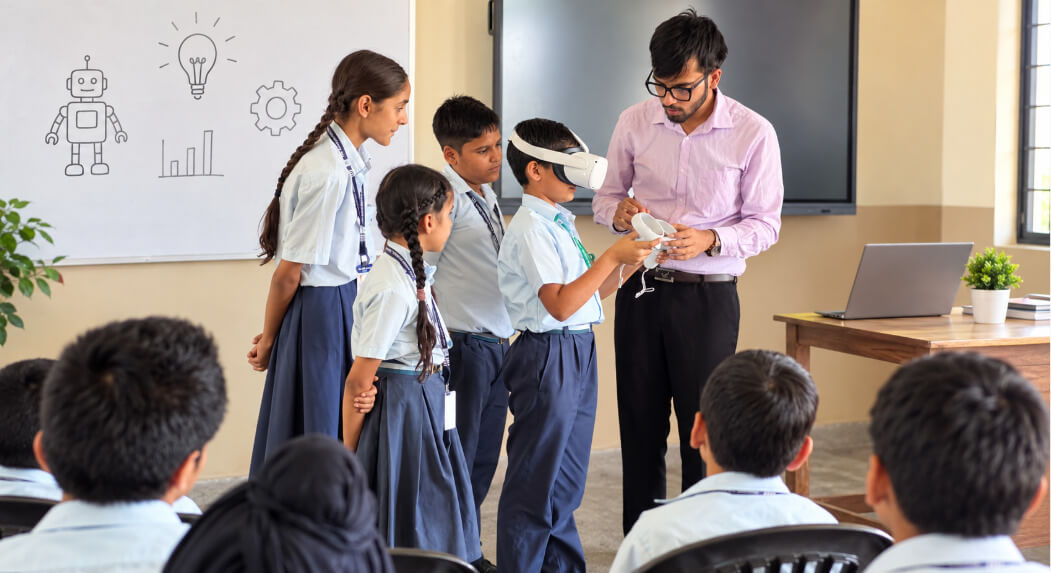
Today it is artificial intelligence, robotics, automation, virtual reality, and technology moving almost faster than we can learn about them.
Children nowadays can ask a question to an AI tool, observe a science experiment from the other side of the world, learn coding on an online platform, construct robots, experience virtual worlds and have access to more information in a few seconds than earlier generations could find in an entire library.
But one thing that technology can’t steal away.
An instructor would tell you, ‘Try again.’
A teacher who sees that a normally quiet child has an idea that deserves to be heard.
An instructor makes a mistake every lesson.
A teacher who can sense potential before the pupil can.
And sometimes a teacher who says, “I think you can do this.”
That is why on Teacher’s Day we need to take a pause from our conversations on AI, coding, STEM, robots and future skills and remember the person who makes all of these things meaningful: the teacher.
The Future May Be Technological. Learning Will Always Be Human.
There is no doubt that technology is transforming education.
AI can generate explanations. Digital platforms can personalise learning. Simulations can make difficult concepts easier to visualise. Robotics can turn abstract ideas into hands-on experiences. Students can explore subjects beyond the walls of their classrooms.
NEP 2020 itself recognises the growing role of technology in education, including emerging technologies such as artificial intelligence, while emphasising its use to improve teaching, learning and teacher professional development.
But technology provides possibilities.
Teachers provide direction.
A child may have access to thousands of answers, but a teacher teaches them to ask the right question.
A child may use AI to generate an answer, but a teacher helps them ask:
Is this answer correct?
Why do you believe it?
What evidence supports it?
Could there be another way to solve the problem?
A child may learn how to build a robot, but a teacher can ask:
“What problem could your robot solve for someone?”
That difference is enormous.
Because future-ready education is not simply about knowing how to use technology.
It is about knowing how, when, why, and responsibly to use it.
Every Future-Ready Child Needs a Guide
We often talk about preparing children for the jobs of tomorrow.
We talk about coding, AI, robotics, computational thinking, creativity, communication, problem-solving, and innovation.
And rightly so.
But skills do not develop in isolation.
Children need people who help them discover those skills within themselves.
A teacher can turn curiosity into inquiry.
A question into an experiment.
An experiment into a discovery.
A failure into resilience.
And an idea into an innovation.
This is one of the reasons inspiring science education goes beyond simply completing a curriculum. When teachers create opportunities for students to question, explore, experiment and discover, students begin to see learning as something they actively participate in rather than something they simply receive.
That is the real power of a teacher.
A teacher does not simply fill a child’s mind with information. A teacher helps a child learn how to think.
The Teacher Who Makes Curiosity Matter
Every child is naturally curious.
They ask:
Why is the sky blue?
How does a phone know my face?
Why does a robot move?
How does a computer understand what I say?
Can a machine think?
What happens if we change this?
What if we try something completely different?
These questions are the beginning of learning.
Research and educational practice increasingly emphasise the importance of curiosity and inquiry in helping students engage deeply with learning. Teachers can create environments where questions are welcomed, experimentation is encouraged, and students have the confidence to explore ideas.
But curiosity needs a guide.
Without guidance, a child may simply collect answers.
With the right teacher, that child can learn to investigate.
And that is a much more powerful skill.
Teachers Teach More Than Subjects
Think back to your school years.
You may not remember every formula you learned.
You may not remember every definition from every textbook.
You may even forget the exact lessons taught in a particular class.
But you probably remember a teacher.
The teacher who encouraged you when you struggled.
The teacher who made a difficult subject interesting.
The teacher who gave you an opportunity when someone else had overlooked you.
The teacher who challenged you to do better.
The teacher who stayed back after class.
The teacher who listened.
The teacher who celebrated your small victories.
The teacher who taught you that failure was not the end.
These moments rarely appear in a report card.
Yet they often stay with us for life.
Because education is not only the transfer of knowledge.
Education is also the transfer of confidence, values, curiosity, discipline, resilience and hope.
The Sacrifice Behind the Classroom
We often see the teacher standing in front of the classroom.
We do not always see everything that happens before and after that moment.
- The lesson was planned late at night.
- The worksheets prepared after school.
- The activities were redesigned because the first approach did not work.
- The extra explanation given to a struggling child.
- The encouragement offered to a student who has lost confidence.
- The countless questions answered.
- The mistakes were corrected.
- The projects reviewed.
- The parents spoke to.
- The new teaching methods learned.
And now, in a rapidly changing educational landscape, teachers are expected to continuously learn new technologies and new approaches themselves.
The profession demands something remarkable:
Teachers must prepare children for a future that they themselves cannot completely predict.
That requires enormous dedication.
The global conversation around education increasingly recognises that teachers need continuous professional development as technology, including AI, changes teaching and learning. The 2026 Global Report on Teachers, for example, highlights lifelong professional learning as essential to supporting teachers and responding to emerging challenges such as AI and changing learning needs.
So when we ask children to become lifelong learners, we should remember the teachers who are lifelong learners themselves.
In the Age of AI, Teachers Become Even More Important
There is a common question today:
“Will AI replace teachers?”
Perhaps the better question is:
“What will teachers become in an AI-powered world?”
AI can become a powerful educational tool.
It can help teachers create resources, support differentiated learning, analyse information and explore new teaching possibilities. UNESCO’s AI Competency Framework for Teachers highlights the need for educators to develop competencies in AI foundations, AI pedagogy, ethics, human-centred thinking and professional learning.
But AI does not know a child in the way a teacher does.
A teacher can notice the hesitation before a child answers.
A teacher can recognise when “I don’t know” really means “I’m afraid I’ll be wrong.”
A teacher can see when a child needs a challenge and when that child needs encouragement.
A teacher can understand the relationships, emotions and circumstances that shape a student’s learning.
That human connection matters.
UNESCO has emphasised that teachers remain irreplaceable because education involves human understanding, emotional connection, socialisation and the development of qualities such as critical thinking, ethical reasoning and emotional intelligence.
AI can assist the teacher. It cannot become the teacher.
We Cannot Conquer New Technologies Without Someone Showing Us the Way
We want children to become AI-ready.
We want them to understand robotics.
We want them to learn coding.
We want them to develop computational thinking.
We want them to become innovators, entrepreneurs, scientists, and problem-solvers.
But before a child can confidently explore a new technology, someone usually has to introduce them to it.
Someone has to make it less intimidating.
Someone has to say:
“Let’s try.”
That person is often the teacher.
A teacher can take a complicated concept and make it simple.
A teacher can connect a technology to a real-world problem.
A teacher can turn a robotics kit into a lesson about perseverance.
A coding error into a lesson about debugging.
An AI-generated answer into a lesson about verification and ethics.
A failed prototype into a lesson about resilience.
That is why future-ready education should never be about choosing between teachers and technology.
It should be about giving teachers the tools, training, and support to use technology meaningfully.
Technology can extend the classroom.
A teacher gives the classroom purpose.
The Teacher as a Mentor, Not Just an Instructor
The role of a teacher is changing.
The teacher is no longer only the person standing at the front of the room delivering information.
The teacher is increasingly a:
Mentor who helps students discover their strengths.
Facilitator who creates opportunities to learn by doing.
Guide who helps students navigate an overwhelming amount of information.
Coach who encourages students through challenges.
Role model who demonstrates curiosity and lifelong learning.
Ethical guide who helps children understand the responsible use of powerful technologies.
And sometimes, simply:
The person who refuses to give up on a child.
This is particularly important in STEM and AI education.
Innovation requires students to experiment.
Experimentation involves failure.
And failure requires a classroom where students feel safe enough to try again.
A teacher creates that environment.
Future-Ready Does Not Mean Technology-Ready Alone
A future-ready child is not simply a child who knows how to use the latest technology.
A future-ready child should also know how to:
- Think critically
- Ask meaningful questions
- Solve unfamiliar problems
- Communicate ideas
- Work with others
- Adapt to change
- Learn continuously
- Make ethical decisions
- Handle failure
- Use technology responsibly
- Understand the impact of their decisions on others
Technology can support many of these abilities.
But teachers nurture them.
Science education, for example, can develop creativity, critical thinking, persistence and innovation when students are given opportunities to question, experiment and learn from trial and error.
The machine may provide information.
The mentor helps build wisdom.
Behind Every Innovator Is Someone Who Believed First
Almost every successful person can point to someone who influenced their journey.
A teacher.
A mentor.
A coach.
A professor.
Someone who noticed something in them.
Someone who opened a door.
Someone who encouraged them to keep going.
Sometimes the teacher does not even realise the impact they have made.
A five-minute conversation can influence a career.
A science experiment can create a lifelong interest.
A competition can build confidence.
A simple “You can do better” can change a student’s attitude towards learning.
A teacher may teach a class of forty students.
But the impact of those forty students can travel through families, organisations, communities and generations.
That is the scale of a teacher’s influence.
This Teacher’s Day, Let’s Look Beyond the Classroom
As schools embrace AI, STEM, robotics, coding and digital learning, we should not lose sight of the human being at the heart of education.
Let’s give teachers opportunities to learn new technologies.
Let’s give them meaningful professional development.
Let’s give them better resources.
Let’s trust their professional judgment.
Let’s recognise their work.
And most importantly, let’s give them the respect that their responsibility deserves.
NEP 2020 itself recognises teachers as central to shaping the future of children and the nation, while also emphasising their continuous professional development.
Because if we want future-ready children, we must first support future-ready teachers.
A Teacher’s Greatest Lesson
The greatest lesson a teacher gives a child may not be found in a textbook.
It may be the courage to ask a question.
The patience to try again.
The confidence to speak up.
The humility to admit a mistake.
The curiosity to explore.
The resilience to continue.
The wisdom to use technology responsibly.
And the belief that there is always something more to learn.
These are lessons that remain valuable even when technology changes.
Because today’s AI may become tomorrow’s old technology.
Today’s programming language may eventually be replaced.
Today’s devices may become obsolete.
But the ability to learn, think, question, create, and care will never go out of date.
And behind the development of those abilities, there will always be teachers.
To Every Teacher: Thank You!
This Teacher’s Day, let us remember that every future scientist needs someone who encourages curiosity.
Every engineer needs someone who teaches them to solve problems.
Every innovator needs someone who told them that their idea mattered.
Every entrepreneur needs someone who encourages them to take the first step.
Every confident learner once had someone who helped them believe in themselves.
And every generation that steps confidently into the future does so because someone took the time to prepare them for it.
Teachers do not simply prepare children for the future.
They help children believe that they have a place in it.
Technology will continue to evolve.
AI will continue to become more powerful.
Classrooms will continue to change.
But one thing will remain at the heart of meaningful education:
A teacher showing a learner the way.
This Teacher’s Day, we celebrate not only what teachers teach, but what they make possible.
To every teacher, mentor, educator, and guide, thank you for showing us the way.
Happy Teacher’s Day!!