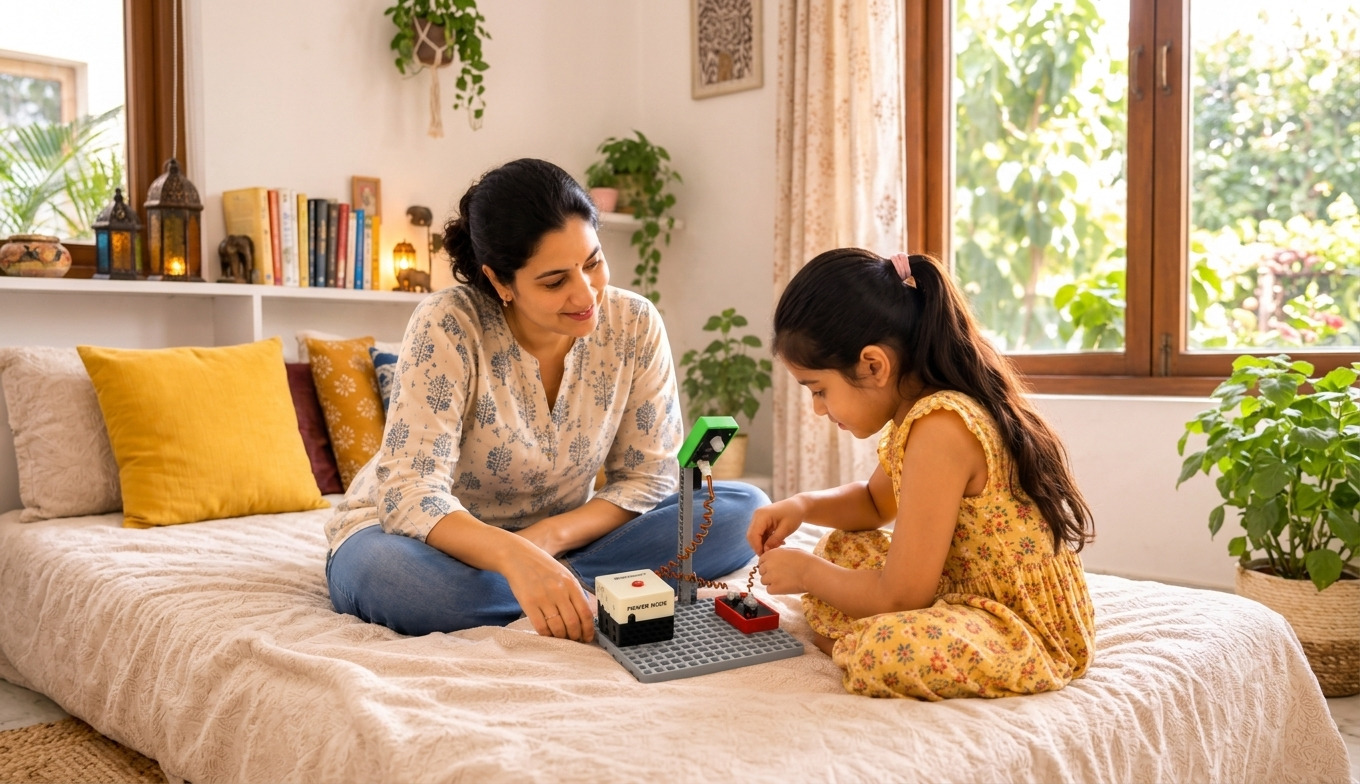
A child may learn a definition today and forget it in a few weeks. But ask that same kid about a robot they created, a circuit they put together or an experiment that went awry, and chances are they will recall the event much more vividly.
This distinction tells us something significant about the way we learn.
Just because you can recall it for a test doesn’t mean you actually comprehend it.
In traditional classroom learning, students are frequently listeners. The teacher teaches an idea, the students write it down, study it, and reproduce it in an examination. This strategy can allow children to collect information. But information does not always transform into useful knowledge.
Research on learning and memory has repeatedly demonstrated that actively collecting and applying information can enhance long-term learning. For example, retrieval practice has been shown to improve retention relative to merely restudying the same information.
This is where project-based learning makes the experience.
Projects give kids a cause to find out how something works rather than just telling them.
Memorising a Concept Is Different From Understanding It
Imagine a student learning about electricity.
In a traditional lesson, the child might memorise:
“Electric current flows through a closed path known as a circuit.”
The definition may be perfectly correct. The student might even score full marks on a question about it.
But what happens when the child is given a battery, wires, an LED and a switch and is asked to make the LED light up?
Suddenly, the definition has a purpose.
The student has to figure out:
- Where should the wires go?
- Why isn’t the LED turning on?
- Is the circuit complete?
- What happens when the switch is opened?
- Why does changing one component affect the entire circuit?
Now the child isn’t simply remembering the meaning of a circuit.
They are experiencing it.
That difference matters.
When children have to recall information, apply it, and solve a problem, learning becomes an active process rather than a passive one. Research on retrieval practice similarly shows that actively bringing information back to mind can strengthen long-term retention and help learners use knowledge in new situations.
Why Hands-On Learning Feels Different
Think about the way children naturally learn outside the classroom.
A child doesn’t learn to ride a bicycle by memorising a definition of balance.
They try.
They wobble.
They fall.
They adjust.
They try again.
Eventually, the body understands something that a textbook could never fully teach on its own.
Project-based learning brings some of this natural process into education.
A student building a robotic car, for example, isn’t just learning about motors. They may simultaneously encounter concepts involving:
- speed and movement
- sensors
- circuits
- programming
- logical thinking
- measurement
- problem-solving
- design
- testing and improvement
One project can connect multiple subjects in a way that a single chapter often cannot.
And because the student is doing something with the knowledge, the learning experience becomes easier to connect with a real situation.
Projects Turn “Why?” Into “Let Me Find Out.”
One of the biggest advantages of project-based learning is curiosity.
A lecture might tell a student:
“An ultrasonic sensor can measure distance.”
A project asks:
“Is it possible to halt a robot before it collides with a wall?”
The second question creates a problem that the child actually wants to solve.
Now the student has a reason to understand the sensor.
They may experiment with different distances. They may change the code. They may discover that their robot stops too late. They may adjust the threshold and test it again.
The teacher doesn’t have to provide every answer immediately.
The student begins asking questions such as:
“What happens if I change this?”
“Why did it stop here?”
“Can I make it react faster?”
That shift—from being given answers to seeking them—is one of the most valuable aspects of experiential learning.
Failure Becomes Part of Learning
There is another important difference between memorisation and projects:
Projects make mistakes visible.
In a traditional learning environment, getting an answer wrong can feel like failure.
In a project, a wrong answer can simply mean:
“Something didn’t work. Let’s find out why.”
A robot doesn’t move.
A sensor gives an unexpected reading.
An LED doesn’t turn on.
A program behaves differently from what the student expected.
These moments create opportunities for debugging and reflection.
Instead of learning that mistakes should be avoided, children learn that mistakes can provide information.
That mindset is particularly valuable in STEM education, where designing, testing, troubleshooting and improving are fundamental parts of real-world problem-solving.
Projects Help Children Connect Different Ideas
Another limitation of memorisation is that subjects can become isolated.
A student may learn mathematics in one period, science in another and computer programming later in the day.
But real-world problems rarely respect subject boundaries.
Imagine a student designing a smart plant-monitoring system.
They might need to understand:
Science: What is the necessity for a plant to grow?
Sensors: How can soil moisture be measured?
Programming: How should the system respond to the sensor reading?
Mathematics: What threshold should trigger an alert?
Design: How should the system be assembled?
Communication: How can the student explain the solution?
Suddenly, multiple areas of learning become part of one meaningful problem.
This is one reason project-based approaches can be particularly powerful in STEM education.
Research examining a technology curriculum that incorporated substantially more multidisciplinary project work found improvements in student retention, collaboration, and independence.
The Child Becomes a Problem-Solver, Not Just a Learner
Perhaps the biggest change happens in the student’s role.
In a lecture-based classroom, the teacher is often the primary source of information.
In a project-based classroom, the teacher becomes more of a guide, mentor, and facilitator.
The student has to participate.
They have to make decisions.
They have to test ideas.
They have to explain what they have done.
They have to find out what went wrong.
This encourages skills that are difficult to develop through memorisation alone:
- Critical thinking
- Creativity
- Collaboration
- Communication
- Problem-solving
- Decision-making
- Persistence
- Independent learning
These aren’t simply “extra” skills.
They are increasingly important in a world where students will eventually have to work with technologies, tools and problems that may not even exist today.
Does This Mean Lectures and Memorisation Are Useless?
Not at all.
This is an important distinction.
Project-based learning should not replace every form of direct teaching.
Children still need explanations, foundational knowledge, demonstrations, reading, practice and feedback.
A student cannot build a meaningful project about sensors without first understanding what a sensor does.
The real question is not:
“Projects or lectures?”
It is:
“How do we combine knowledge with purpose?”
A teacher might first introduce a concept, demonstrate it, and then give students a challenge where they have to use that concept.
That combination can be much more powerful than either approach on its own.
Research on learning also supports using active strategies such as retrieval and spaced practice rather than relying only on repeated exposure to information.
From “What Is It?” to “What Can I Do With It?”
This may be the most important shift education can make.
Instead of stopping at:
“What is artificial intelligence?”
we can ask:
“Where do you see AI around you?”
Instead of only teaching:
“What is a sensor?”
we can ask:
“Can you use a sensor to solve a real problem?”
Instead of asking only:
“What is coding?”
we can challenge students:
“Can you program something to respond to its surroundings?”
The first type of question checks whether a child remembers information.
The second encourages the child to use knowledge.
And here learning becomes more meaningful.
What Project-Based Learning Can Look Like in a School
Project-based learning doesn’t necessarily mean every lesson needs a huge, complicated project.
It can begin with something very simple.
A science lesson on temperature could become a small weather-monitoring activity.
A lesson on light could become a smart darkness detector.
A programming lesson could involve creating a simple automated response.
A robotics lesson could challenge students to build a vehicle that detects obstacles.
An AI lesson could involve training a model to recognise different objects or colours.
The important part isn’t how expensive or complicated the project is.
The important part is that the student has something to investigate, build, test or improve.
Building the Future of Learning
Education is not only about helping children remember information until the examination is over.
It is about helping them understand information well enough to use it as situations change.
A child who memorises how an ultrasonic sensor works may remember a definition.
A child who uses that sensor to build an obstacle-detecting robot has experienced the concept in action.
That experience can create connections between knowledge, curiosity, problem-solving and real-world application.
And perhaps that is the real strength of project-based learning.
Children don’t just learn about things. They learn by doing things.
They build.
They experiment.
They make mistakes.
They ask questions.
They try again.
And eventually, they don’t just remember the answer.
They understand why it works.
For schools looking to make STEM, robotics, AI, and technology education more practical, this is the direction worth exploring: less passive consumption, more meaningful creation.