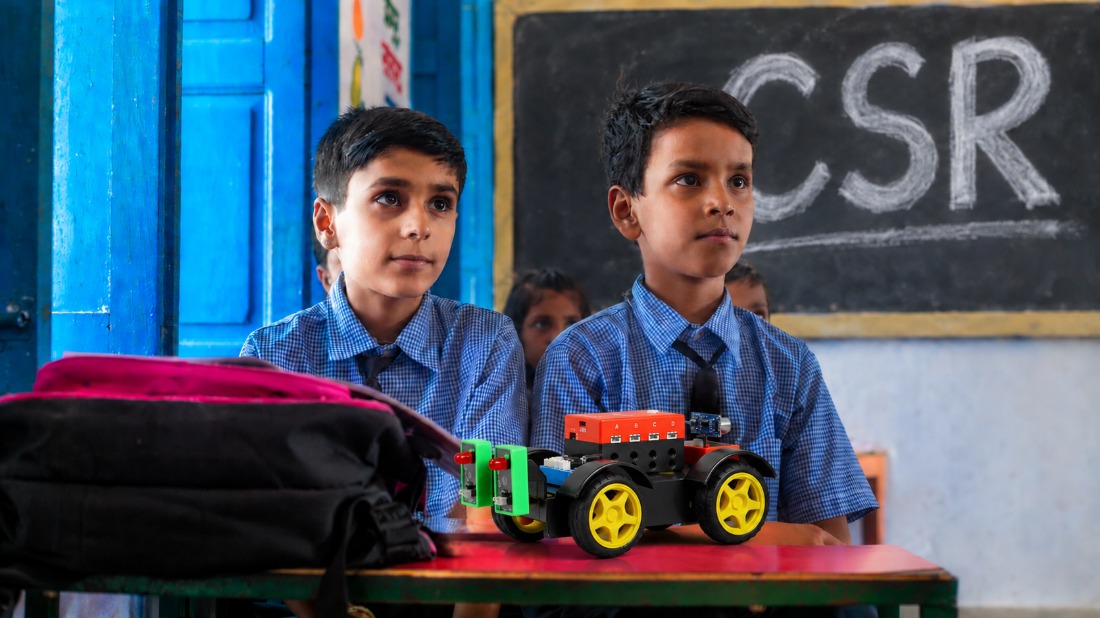
What Is CSR Fund? Today, firms need to do more than generate economic growth. Companies are becoming more aware of the impact their decisions have on employees, communities, the environment and society as a whole.
This is where Corporate Social Responsibility (CSR) comes into the picture.
Corporate Social Responsibility means that firms have to take responsibility for their social, environmental and ethical effect while they continue to operate and expand. CSR can take different forms such as supporting education and health care, boosting skill development, safeguarding the environment and contributing to community development.
But CSR isn’t just about providing money.
The true value of CSR lies in the transformation of resources into social impact that is meaningful and measurable.
Education is one area where CSR can really make a difference for firms that want to make a difference that really counts. Quality learning, technology, and future-ready skills for kids can impact their possibilities for years to come.
What Is Corporate Social Responsibility?
This is called Corporate Social Responsibility (CSR) – the way in which companies think about and deal with their societal and environmental effect.
A socially responsible organization considers its responsibility to its larger stakeholders (workers, customers, communities and the environment) beyond its financial performance. CSR is the duty of businesses for their impact on society. As UNESCO says, ‘Responsible behavior must go beyond compliance with the law or the pursuit of profit.
In practice, CSR may include:
- Education and health care assistance
- Job creation and skills development
- Protecting our environment.
- Uplifting underserved communities
- Advocating ethical business practices
- Promoting employee volunteering
- Technology and learning resources available
- Community development assistance programs
The exact approach differs from company to company. The important thing is that the effort is addressing a real need and generating real value.
What Is CSR Fund Meaning?
CSR fund is the sum allocated by the corporation for the relevant Corporate Social Responsibility activities and projects. These monies may be directed to sectors such as education, healthcare, skill development, environmental sustainability, and community development depending upon the CSR provisions prevailing and the aims of the company.
Why Is CSR Important for Businesses?
Businesses are firmly established in the areas they serve. They create jobs, use resources, work with suppliers, serve customers and influence the local economy.
As a result, responsible business practices have become increasingly important.
CSR can help organisations contribute to society while also strengthening relationships with their employees, customers and communities. Research and business analysis also associate responsible business practices with areas such as reputation, employee engagement and stakeholder trust.
However, CSR should not be approached only as a branding exercise.
A successful CSR initiative starts with a simple question:
What meaningful difference can we create?
That question shifts the focus from spending a CSR budget to creating actual impact.
CSR in India: Creating Social Impact Through Business
CSR in India has come up as a significant way to encourage the corporate community to contribute toward social and environmental development. In India, the CSR framework is a formal mechanism for eligible firms to donate toward causes such as education, healthcare, skill development, environmental sustainability and community development.
CSR is an opportunity for companies to channel resources to deserving social causes. Carefully designed CSR efforts can create access to resources, information, technology and opportunities that can lead to long-term development for communities.
In India, education is a very important aspect of CSR as access to quality education and future-ready skills can open doors far beyond an individual CSR project.
What Are the Main Areas of CSR?
CSR can cover a wide range of activities. Four broad areas are commonly discussed.
Environmental Responsibility
This focuses on reducing environmental impact and protecting natural resources.
Examples include:
- Waste reduction and recycling
- Water conservation
- Renewable energy
- Tree plantation
- Reducing emissions
- Environmental awareness programmes
Social Responsibility
Social CSR focuses on improving people’s lives and supporting communities.
This can include:
- Education
- Healthcare
- Skill development
- Community development
- Scholarships
- Support for underserved groups
Ethical Responsibility
Businesses are also expected to operate fairly and responsibly.
This includes:
- Fair treatment of employees
- Safe working conditions
- Transparency
- Responsible sourcing
- Protecting customer information
- Following applicable laws and regulations
Economic Responsibility
Businesses need to remain economically sustainable while contributing positively to society.
It may include job creation, support for innovation, promotion of entrepreneurship, and contribution to local economic Identify the Need development.
These areas are not always separate. A single CSR programme can address several of them at the same time.
For example, a company supporting technology education in an underserved school may contribute to social development, digital inclusion, skill development, and future employability.
What Are Common CSR Activities?
CSR activities might be a local community activity or a huge long-term program.
Typical instances are:
Education: Scholarships, digital learning, school infrastructure, learning resources, STEM programs, and teacher development
Healthcare: Medical camps, health awareness programs and healthcare support
Skills Development: vocational training, digital skills, entrepreneurial and employability programs
Environment: Tree plantation, garbage management, clean energy projects, conservation programs.
Community Development: Rural development, support to livelihood and social welfare programs.
Disaster Relief – Emergency aid, rehabilitation and community recovery.
In particular, UNESCO’s CSR framework prioritizes education-related activities such as enhancing learning environments, providing ICT equipment, boosting connection, promoting teacher professional development and building digital and practical technology skills.
That is why education is a key area for companies to achieve a long-term societal influence.
Why Education Is a Powerful Area for CSR
Education can transform a child’s future.
When students gain access to quality learning, technology, trained teachers, and practical experiences, they are better positioned to develop knowledge and skills that can support their future.
Yet many children, particularly those from underserved communities, may have limited access to modern learning resources and technology.
This is where education-focused CSR can make a difference.
A company can use its CSR investment to support:
- AI Lab
- STEM education
- Robotics and coding
- Artificial Intelligence awareness
- Innovation programmes
- Science and mathematics learning
- Teacher training
- Educational kits
- Digital infrastructure
- Technology-enabled classrooms
- Future-ready skill development
The objective should not simply be to put equipment into a classroom.
The objective should be to create opportunities for students to learn, practise, experiment and grow.
From CSR Funding to Classroom Impact
Allocating a CSR budget is only the beginning.
The bigger challenge is ensuring that the funding reaches the right schools, addresses genuine needs and results in meaningful learning opportunities.
For example, providing a school with a technology lab can be valuable. But the impact becomes much stronger when the programme also includes teacher support, structured learning activities, student projects, maintenance, and continuous engagement.
This is the difference between supporting infrastructure and building a learning ecosystem.
A well-designed education CSR programme can bring together:
CSR Funding + Infrastructure + Learning Resources + Teacher Support + Student Activities + Technology + Monitoring
Together, these elements can help create a more sustainable educational impact.
How Shikshak Solutions Helps Companies Utilise CSR Funds for Education
This is where Shikshak Solutions aims to bridge the gap between CSR investment and educational impact.
Many organisations want to use their CSR fund to support education, but implementing an effective education programme requires more than financial resources. Companies may need help identifying appropriate schools, understanding educational requirements, selecting suitable interventions, implementing programmes, and ensuring that students actually benefit from them.
Shikshak Solutions helps organisations channel their CSR efforts towards education and future-ready learning for underserved and underprivileged children.
Our focus is on helping CSR partners use their resources to create meaningful learning opportunities for students who may otherwise have limited access to modern educational experiences.
Depending on the needs of the school and the scope of the programme, CSR projects can support areas such as:
- STEM education
- Robotics and coding
- Artificial Intelligence learning
- Digital literacy
- Innovation and hands-on learning
- STEM and Composite Labs
- Educational kits and learning resources
- Teacher training
- Technology-enabled learning
- Future-ready skills
The aim is simple:
To help CSR funds reach the classroom and create opportunities where they are needed most.
What Can an Education-Focused CSR Programme Look Like?
Every school and community has different needs. Therefore, CSR programmes should not follow a one-size-fits-all model.
A programme could begin with understanding the school’s existing infrastructure, student needs and learning environment.
Based on this assessment, the CSR initiative may focus on providing:
Learning Infrastructure
Schools can be supported with technology-enabled learning spaces, STEM labs, innovation spaces or other educational infrastructure.
Educational Resources
Students and teachers can receive kits, learning materials and digital resources that support practical learning.
Technology Exposure
Students can be introduced to areas such as coding, robotics, artificial intelligence, electronics and other emerging technologies.
Teacher Support
Teachers can receive training and guidance to help them use new tools and learning methodologies effectively.
Hands-On Learning
Instead of learning only through textbooks, students can participate in experiments, projects, challenges and practical activities.
Continuous Engagement
Long-term programmes can include regular activities, mentoring, assessments and monitoring rather than stopping after infrastructure is installed.
This approach helps ensure that the CSR investment becomes part of the students’ actual learning journey.
Why CSR in Education Should Go Beyond Donations
A donation can solve an immediate problem.
Education, however, often requires continuous support.
Giving a school a computer is useful. The impact can be far higher when you help teachers and kids understand how to use the technology in meaningful ways.
Likewise, the establishment of a STEM laboratory is just the beginning. Students should have regular opportunities to experiment, develop projects, solve difficulties, and use the lab.
This is why education-focused CSR should consider the complete journey:
Access → Exposure → Learning → Practice → Application → Skill Development
We want to help youngsters become confident learners and problem solvers, not mere recipients of resources.
How Companies Can Build an Effective CSR Education Programme
A meaningful CSR programme requires planning.
1. Identify the Need
Start by understanding the actual educational challenges faced by the target community.
Is the need infrastructure? Technology? Teacher training? Digital literacy? STEM exposure? Learning resources?
2. Identify the Right Schools and Communities
The programme should reach students who can benefit from the intervention.
Understanding the local context is important because the same solution may not work equally well in every school.
3. Design the Programme
The intervention should have clear objectives, activities, timelines and expected outcomes.
4. Implement With the Right Partners
Schools, teachers, implementation partners and communities all have a role to play.
The right implementation partner can help translate the CSR vision into classroom-level activities.
5. Train and Support Teachers
Infrastructure alone cannot transform learning. Teachers need the confidence and skills to use new resources effectively.
6. Engage Students
Students should actively participate through projects, experiments, activities, and practical learning.
7. Monitor and Measure Impact
A CSR programme should track meaningful outcomes rather than only measuring how much money was spent or how many resources were distributed.
This could include indicators such as student participation, teacher engagement, learning activities conducted, skills developed and programme reach.
8. Plan for Long-Term Sustainability
The best CSR programs don’t end after the first deployment.
Schools should be supported to continue using the resources and learning systems after the initial project period.
UNESCO also highlights monitoring and evaluation, stakeholder engagement, and long-term sustainability as important considerations for effective CSR implementation.
Benefits of CSR: How Companies and Communities Can Benefit
When CSR resources are directed towards education thoughtfully, the benefits can extend across multiple levels.
For Students
Students can gain:
- Access to better learning resources
- Technology exposure
- Practical learning opportunities
- STEM and digital skills
- Greater confidence
- Problem-solving abilities
- Exposure to future career pathways
For Schools
Schools can benefit from:
- Improved learning infrastructure
- Technology-enabled education
- Teacher development
- New learning opportunities
- Innovation-focused programmes
- Stronger engagement with communities
For Companies
Companies can:
- Create measurable social impact
- Support underserved communities
- Build stronger stakeholder relationships
- Engage employees in meaningful initiatives
- Contribute to education and skill development
Most importantly, the community benefits when CSR resources are converted into opportunities that can improve children’s learning and prospects.
CSR, Technology and Future-Ready Education
The world of employment is changing fast.
Students are developing in an environment that is centred on artificial intelligence, automation, robotics, digital platforms and emerging technologies.
Education should equip youngsters with the opportunity to learn how to understand and utilise technology appropriately.
CSR may assist in bridging this gap by supporting access.
- Online education
- Programming
- Robotics.
- Artificial Intelligence
- STEM schooling
- Computation thinking
- Innovations projects
- Solutions of problems by technology
Such experiences can be particularly important for youngsters in underserved communities who may have limited access to them otherwise.
CSR can be a bridge between resources and opportunities.
What Challenges Should Companies Consider?
CSR programmes can create significant impact, but they also have challenges.
Some common concerns include:
- Understanding the actual needs of communities
- Reaching the right beneficiaries
- Ensuring resources are used effectively
- Training teachers
- Maintaining infrastructure
- Measuring long-term outcomes
- Coordinating multiple stakeholders
- Avoiding short-term interventions
- Ensuring that CSR claims reflect genuine impact
A school may receive advanced technology, for example, but without appropriate teacher support and regular student engagement, that technology may remain underused.
This is why implementation matters as much as investment.
The Future of CSR in Education
The future of CSR is likely to move increasingly towards programmes that are measurable, technology-enabled and focused on long-term outcomes.
Education can play a major role in this shift.
Companies can support children not only through traditional infrastructure, but also by providing opportunities to develop skills in areas such as STEM, coding, robotics, AI, digital literacy and innovation.
The focus can gradually move from:
“What did we provide?”
to:
“What did students acquire, and what opportunities did we generate?”
That is a more meaningful way to look at social impact.
Frequently Asked Questions About CSR
What is Corporate Social Responsibility?
Corporate Social Responsibility (CSR) is the manner in which corporations behave responsibly in relation to their social, environmental, and ethical impact and give something back to society.
What is a CSR Fund?
A CSR fund refers to the amount allocated by a company towards eligible Corporate Social Responsibility activities and projects. Such funds can support initiatives in areas such as education, healthcare, skill development, environmental sustainability and community development, subject to applicable rules and requirements.
Why is CSR important?
CSR helps firms to contribute to social and environmental development and to create responsible partnerships with the communities, employees and other stakeholders.
What are some common CSR activities?
Some of the common CSR activities are education, health, skill development, environment, community development, disaster assistance and employee volunteerism.
How can CSR support education?
CSR may help education through school infrastructure, digital learning, STEM programmes, educational resources, teacher training, technology access and skill development activities.
How can companies use CSR funds for education?
Companies can work with the right education or implementation organisations to locate schools, analyse their needs, devise programmes, give resources and monitor outcomes.
Can CSR support STEM and technology education?
Yes, CSR projects in the education space can assist technology infrastructure, digital skills, STEM learning, coding, robotics, AI awareness and other practical learning possibilities.
Is CSR only about donating money?
No, CSR might encompass financing, technology, equipment, employee volunteerism, professional experience, training, mentorship, collaborations and long-term community activities.
How does Shikshak Solutions support CSR initiatives?
Shikshak Solutions helps organisations employ their CSR resources for education-focused initiatives, particularly programmes that can assist underserved and impoverished children with access to learning opportunities, technology, STEM education and future-ready skills.
Creating Opportunities Through CSR
Corporate Social Responsibility is ultimately about responsibility, but its greatest potential lies in impact.
A CSR budget can become infrastructure.
Infrastructure can become a learning space.
A learning space can become an opportunity.
And an opportunity can change the future of a child.
At Shikshak Solutions, we believe CSR can play an important role in making quality education and future-ready learning more accessible to children who need it most.
By helping organisations direct their CSR resources towards meaningful educational initiatives, we aim to connect companies that want to create impact with schools and students who need greater opportunities to learn and grow.
Because the success of CSR should not only be measured by the amount invested.
It should also be measured by the knowledge gained, skills developed, opportunities created, and lives touched.
When CSR reaches the right classroom, it can help build a better future – one child at a time.
CSR in India: https://www.csr.gov.in/content/csr/global/master/home/home.html