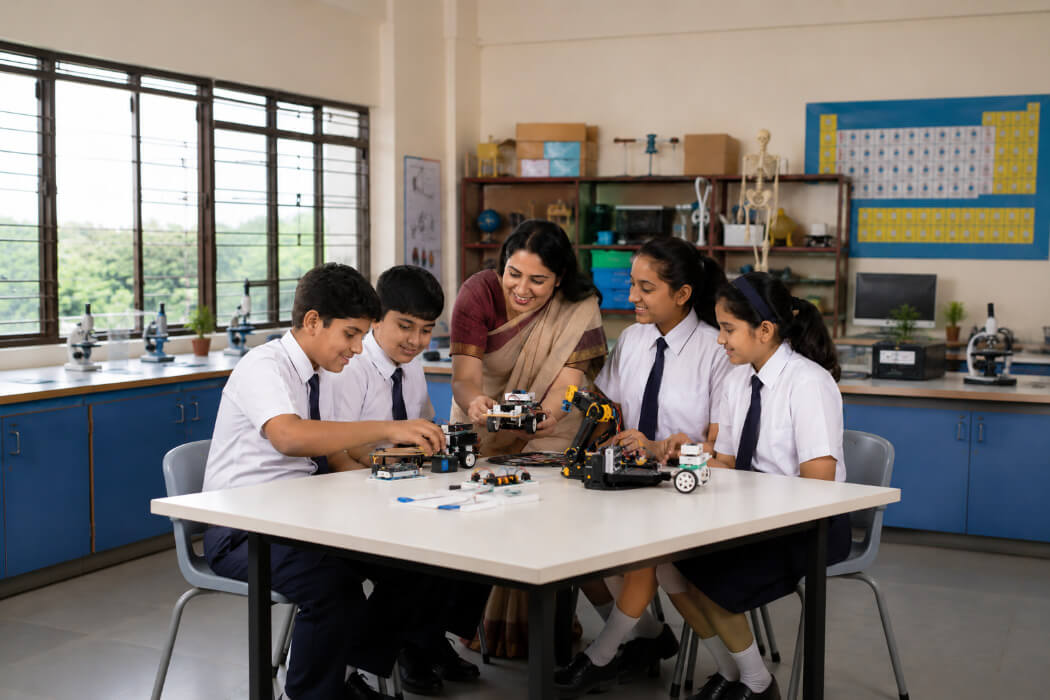
When we talk about offering our kids the greatest education, we focus on classroom infrastructure, smarter technology, digital learning platforms, sophisticated laboratories, AI tools, coding programs, and hands-on activities. All of these are vital in schooling, especially as future talents grow.
The teacher must never be overlooked.
Because even the best classroom cannot replace the teacher who motivates students to learn.
A teacher’s expertise matters. How they communicate knowledge, the questions they ask, their patience, the examples they use, and, most significantly, the confidence they foster in a youngster all matter.
A good instructor may make a tough subject seem easy. They can create exploration from a simple question. They can spot a student’s tentativeness, support a child who has lost confidence, and foster a setting where “I don’t know” is the start of learning.
Preparing children for a future molded by STEM, AI, coding, robots, and other technologies makes this function even more crucial.
Technology provides tools.
Spark comes from teachers.
We All Remember That One Teacher
After school, we all recall a teacher.
Our career topic may not have been taught by that teacher. Perhaps it wasn’t the teacher we valued most at the time.
Maybe a teacher thoroughly explained a difficult idea for the third time.
The one who noticed your unusual stillness.
She told you to join when you were afraid you’d be incorrect.
Someone who looked at your work and said, “You can do better” out of genuine belief.
Sometimes the teacher made a subject less terrifying.
For many teachings, we may forget the details. My assignments, worksheets, even parts of chapters I studied for months may be forgotten.
We rarely forget the one who made us feel capable.
That makes teaching fascinating.
Lessons can last a few minutes. The impact of a teacher might last decades.
Maybe that’s why every generation can remember a teacher who changed how they learned, thought, or saw the world.
A Teacher Does Not Simply Teach a Subject
Traditional education holds that teachers have knowledge and students don’t, and teachers teach.
Makes sense.
However, real learning is rarely easy.
If education were only knowledge transfer, textbooks and search engines would have solved the problem long ago.
Teachers do much more.
A student may know the formula but not when to use it.
They may memorize the definition of an algorithm but not how to apply computational thinking to a situation.
They may know what artificial intelligence is but never how it works.
They may know plants need sunlight, but they rarely analyze how this knowledge can solve an environmental issue.
The educator links knowledge and comprehension.
Questions usually make that link. “Why do you think this happened?”, “What if we changed this?”, “Can you think of another way?”, “How do we evaluate your idea?”
Though simple, the questions are powerful.
They make students think actively.
Curiosity Is Where Learning Begins
Children are naturally curious.
Is the sky blue? Why?
What moves a shadow?
A TV works how?
Magnetic materials attract some materials but not others. Why?
How do computers recognize faces?
A machine that learns?
Could we create a solution?
Children don’t immediately call these questions “science,” “technology,” “engineering,” or “mathematics.”
They inquire.
Teacher curiosity is a powerful tool.
Queries and curiosity can help kids go from memorization to independent study. Students might find science more interesting by asking questions, exploring possibilities, and making connections.
Inquiry needs a home.
Children may cease trying if continuously told there is just one way.
Shocked for asking a “silly” inquiry, a child may quit raising their hand.
Always seeing mistakes as failure can make a child afraid to try new things.
The teacher bridges here.
Good teachers recognize that questions don’t hinder learning. Inquiry often begins learning.
They might suggest students investigate instead of answering immediately.
What a teacher can do best sometimes:
In your opinion?
Student ownership comes from that simple question.
Creativity Is Not Just for the Art Room
When we hear the word creativity, painting, music, storytelling, or other kinds of art generally come to mind.
But creativity has always been closely associated with science and technology.
All inventions were once something that did not exist yet.
Behind each engineering solution was someone thinking of another potential.
All scientific research is driven by a desire to understand something that is not fully understood.
This is why creativity is so vital to STEM education.
When a student builds a robotic model, he or she is not just assembling parts.
They are making a decision.
What is the machine supposed to do?
How should it reply?
But what if the value reported by the sensor is different?
Can we do better with the design?
When a student writes code, they aren’t only learning syntax.
They break down a problem, look for patterns, test logic, and strive to make their idea work.
And if the first try doesn’t work, as it often doesn’t, they get to try thinking creatively again.
What happened?
What can I do differently?
Can I view the situation from a different angle?
This is the kind of thinking that cannot always be developed using textbooks.
It needs room to experiment.
It takes license to make mistakes.
And it takes a teacher who recognizes that the wrong response can sometimes be more instructive than the right one.
The Invisible Work Behind Every Successful Lesson
Another side of teaching are rarely seen by pupils is ‘the preparation ‘.
A teacher may teach 40 minutes.
Students learn in 40 minutes.
For the teacher, they may represent hours of work.
Textbooks, notes, concepts, examples, activities, and questions may have been involved.
Teachers may have considered how to teach different learning speeds.
Which example would familiarize the topic may have been considered.
Since an exercise wouldn’t work for their class, they may have changed it.
They may have wanted a simpler explanation of a complex concept.
After all that preparation, the class may pose an unexpected question.
Teachers do that.
An easy explanation often requires a lot of labor.
The final lesson.
Not usually do we perceive the work that enabled the lesson.
STEM teachers may need to learn new technologies, procedures, experiments, and transdisciplinary concepts.
Technological progress is rapid.
Both pupils and teachers are learners.
This is serious work.
The Teacher Is Also a Learner
Modern instructors are becoming lifelong learners, which is fantastic.
AI evolves.
Coding environments evolve.
Robotics is becoming more accessible.
Digital tools are entering classrooms.
New experiential and inquiry-based learning methods emerge.
A teacher can’t always use what they learned years ago.
This does not mean teachers must instantly master every new technology.
They must remain curious.
That may be one of the most powerful things a teacher can teach kids.
When teachers say, “I haven’t used this before, but let’s explore it,” they demonstrate value.
They demonstrate to kids that learning is permanent.
A lifetime habit.
Such an approach may be more beneficial than mastering one tool or technology in a rapidly changing world.
STEM Needs Teachers, Not Just Tools
Schools today have more STEM materials at their disposal than ever before.
Robotic kits may teach pupils about engineering.
Sensors can convert abstract ideas into data that is measurable.
Coding platforms may unlock programming for people.
AI technologies can reveal how machines “understand” information.
Students can examine problems that are not easy to reproduce physically with digital simulations.
These tools are useful.
But tools don’t teach themselves.
An unopened robotics kit on a shelf is just a bunch of parts.
It becomes relevant when a teacher pushes students to make something, test it, question it, and improve it.
When a teacher gets students to think about the problem they are trying to solve, not just follow a set of instructions, a coding platform becomes more than an interface.
An AI tool becomes an educational experience when students are asked to challenge its output, verify information, and think about its limitations.
That is why technology should never be seen as a substitute for instructors.
The more advanced the tool, the more vital intelligent direction becomes.
From Curiosity to Confidence
A student asks a question. Curious
But confidence gives them the boldness to keep asking.
This is possibly one of the greatest gifts a teacher can provide.
Imagine a student who constructs a project, and it fails.
The student’s initial response can be dissatisfaction.
But an experienced instructor may see something else.
They sense an opening. “Why didn’t it work? What portion do we inspect first?” “What might we change?”
Failure is not the end of the road now.
It becomes information.
This is precisely the mindset needed in STEM students.
Real-world problems do not normally come with instructions that read:
Step 1. Step 2. Step 3. Right answer.
Scientists do experiments.
Engineers redesign.
Programmers debug.
Inventors fail, and try again.
Researchers are challenging their assumptions.
If we want kids to be comfortable with this process, the classroom has to allow them to experience it.
And instructors are the ones who can make those encounters count.
A Teacher Does Not Need to Have Every Answer
Teachers should always know.
However, in a fast-moving knowledge environment, we may need to redefine competence.
Teachers should not know everything.
They must help students discover, appraise, and understand what they don’t know.
This distinction is important in AI and creating technologies.
An unfamiliar tool can challenge a teacher.
They can explore it with pupils without being the expert.
That can alter the classroom dynamic.
The instructor guides inquiry.
The student participates.
Learning becomes collaborative.
That’s beautifully human.
Because education was never designed to be a knowledge race.
It involves creating a culture everyone wants to study.
The Teacher Can Be Anyone
When we talk about teachers, we normally picture someone standing in front of a classroom,
But some of our first teachers never even set foot in a classroom.
Our parents educate us on how to talk, how to communicate, how to understand the world.
Older siblings teach us things we would not learn anywhere else.
A grandmother may have practical wisdom that no book can contain.
A neighbour might teach a child how something works.
A mentor can give a young person the courage to explore a passion he or she would never have otherwise considered.
A coach can teach discipline and resilience.
So a teacher does not necessarily have to be a vocation.
Sometimes a teacher is just someone who helps another person view something a different way.
And for a child, these impacts might come from numerous places.
The school instructor may present a scientific concept.
The parent might tell the child to make something at home.
The mentor may expose them to a competition.
All of these encounters combine to shape the learner.
The Future Belongs to Problem-Solvers
We hear a lot about students needing to be “future-ready.”
But being future-ready is more than simply knowing the latest technology.
Technology will keep changing.
The programming languages you learn today are subject to change.
“Tomorrow, the AI tools they are using today could be completely different systems.”
The positions people get may have no resemblance to the occupations they now hold.
So what should stay constant?
The power of learning.
The ability to ask questions.
The bravery to attempt.
Critical thinking abilities.
The imaginative capacity to envision alternatives
The persistence of getting up again after failing.
These are the qualities that can help pupils deal with an uncertain future.
And these qualities are not acquired simply by adding another topic to the timetable.
They are created via experience and through the teachers who produce that experience.
Behind Every STEM Learner Is a Human Connection
It is easy to fall in love with the technology that surrounds modern education.
We’re talking about AI-powered schools.
We are talking about robots.
We discuss coding.
We learn digitally and discuss smart labs.
But at the heart of each of these breakthroughs is still a human relationship.
An instructor detects a student’s fascination with machinery.
An instructor answers a weird inquiry from another student.
A teacher sees possibilities in a struggling person.
The teacher provides the pupil confidence to take part in the project.
A teacher tells them their proposal is worth looking into.
These events may never be documented in a curricular document.
They may not be caught by an assessment.
But they can steer a student’s life in the right way.
Sometimes a child’s future starts with something as simple as a teacher saying:
“This is a really interesting idea. Tell me more.”
This Teachers’ Day, Let’s Appreciate What Happens Behind the Scenes
Teachers’ Day is often celebrated with greetings, cards, flowers, performances and social media messages.
And there is nothing wrong with that.
Teachers deserve appreciation.
But perhaps we can go one step further and recognise the work that happens when nobody is watching.
The hours spent preparing a lesson.
The additional reading required to understand a topic.
The activity that had to be redesigned.
The explanation repeated for the student who needed more time.
The papers checked after a long day.
The conversation with a student who had lost confidence.
The encouragement given after a failed attempt.
The curiosity that was taken seriously.
The small achievement that was noticed.
These are the moments that rarely make it into the formal story of education.
Yet they are the moments that make education human.
The Real Science Behind an Inspiring Teacher
It is easy to fall in love with the technology that surrounds modern education.
We’re talking about AI-powered schools.
We are talking about robots.
We discuss coding.
We learn digitally and discuss smart labs.
But at the heart of each of these breakthroughs is still a human relationship.
An instructor detects a student’s fascination with machinery.
An instructor answers a weird inquiry from another student.
A teacher sees possibilities in a struggling person.
The teacher provides the pupil confidence to take part in the project.
A teacher tells them their proposal is worth looking into.
These events may never be documented in a curricular document.
They may not be caught by an assessment.
But they can steer a student’s life in the right way.
Sometimes a child’s future starts with something as simple as a teacher saying:
“This is a really interesting idea. “Tell me more.”
From Curiosity to Confidence
Perhaps the best way to describe the role of a skilled teacher is this:
They bridge the gap between curiosity and confidence.
Curiosity makes a child ask, “Why?”
Creativity encourages them to ask, “What if?”
STEM gives them opportunities to explore, build, test, and solve.
And a teacher stands beside them through the process.
When the experiment works, the teacher celebrates the discovery.
When it fails, the teacher asks what can be learned from it.
When the student is uncertain, the teacher encourages another attempt.
When the child finally understands, the teacher knows that something more important than a correct answer has happened.
The student has realised:
“I can figure this out.”
That confidence may travel far beyond the classroom.
It may influence the subjects they choose, the problems they attempt, the risks they take and the possibilities they imagine for themselves.
And that is why the work of a teacher is so much bigger than a lesson plan.
The First Spark Behind Every Future Innovator
We cannot predict exactly what today’s students will invent tomorrow.
Some may become scientists.
Some may become engineers.
Some may develop AI systems.
Some may write code.
Some may work in fields that do not yet exist.
Others may use the skills they develop through STEM in completely unexpected ways.
But somewhere along the way, many of them will remember the person who made them curious.
The person who encouraged the question.
The person who gave them another chance after failure.
The person who made a difficult subject feel possible.
The person who said, “Try it.”
That is the teacher.
And while technology will continue to transform the way education is delivered, that human role will remain irreplaceable.
Because the future does not simply need children who know more.
It needs children who are willing to question more, imagine more, experiment more and learn continuously.
And behind that kind of learner, there is often a teacher who understood one simple truth:
You cannot teach curiosity by giving students all the answers. You teach it by giving them a reason to keep asking questions.
This Teachers’ Day, let us celebrate those teachers not only for the lessons they teach, but for the curiosity they protect, the creativity they encourage, the confidence they build and the possibilities they help children see in themselves.
Because long before a student becomes an innovator, engineer, scientist, coder or inventor, there is usually someone who gave them their first reason to believe:
“I can.”