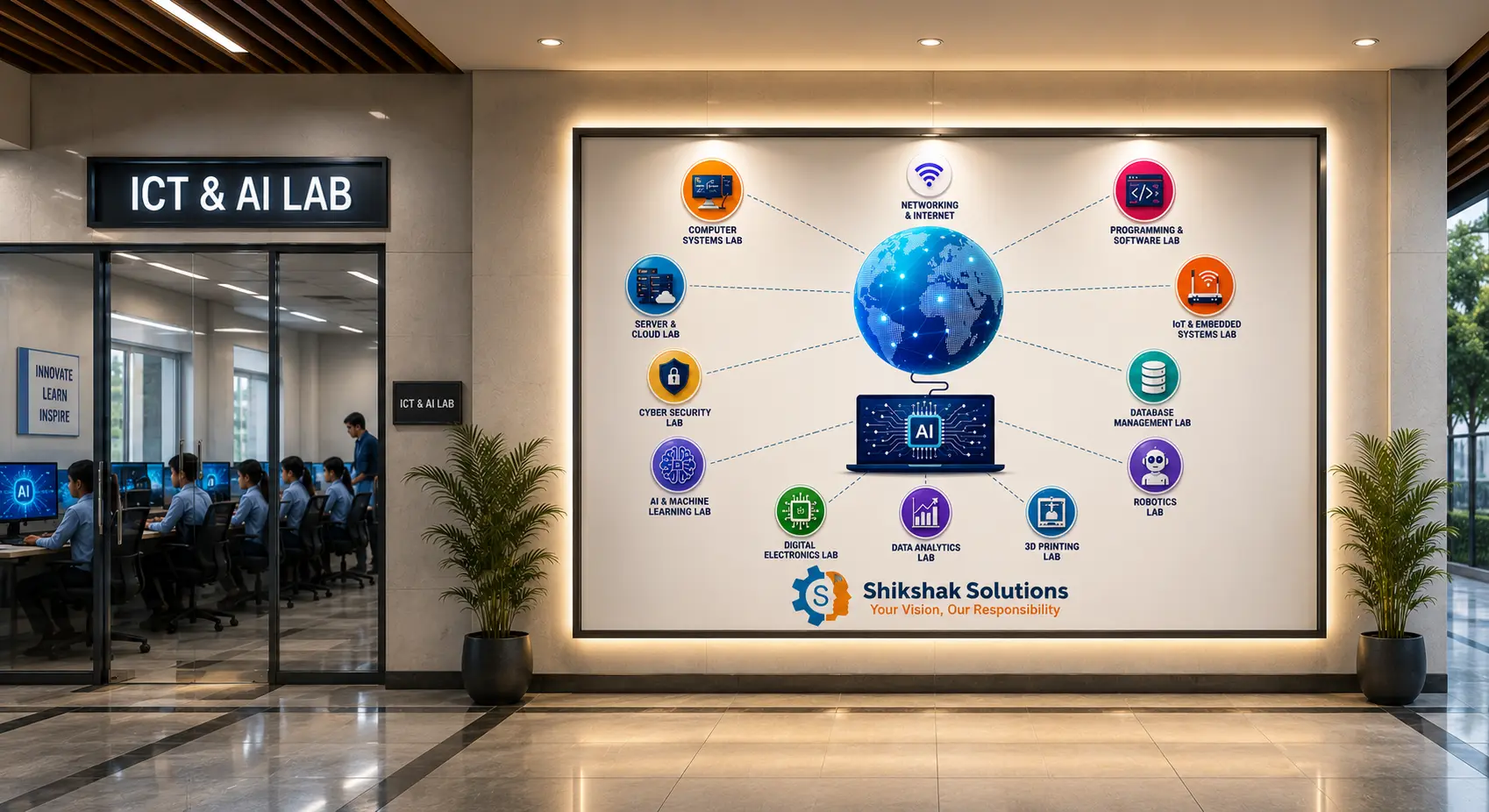
Education is changing more quickly than ever before. Students today are being raised in a world powered by technology, artificial intelligence, automation, and digital communication. Schools must move beyond traditional teaching techniques and embrace technology-enabled education to equip learners for this quickly changing environment.
Here is where Information and Communication Technology (ICT) in education is crucial.
Computers have moved out of the computer lab and are no longer limited to occasional digital presentations. It has become an integral part of modern teaching and learning, helping schools to create engaging classrooms, improve learning outcomes, develop future-ready skills and align with the national education reforms like the National Education Policy (NEP) 2020 and the latest CBSE Computational Thinking (CT) and Artificial Intelligence (AI) Guidelines 2026.
Schools that invest in ICT today are not just using technology; they are equipping kids for tomorrow’s opportunities.
What is ICT in education?
Information and Communication Technology in Education (ICT in Education) refers to the implementation of digital technology, gadgets, software, internet-based resources and communication tools to support teaching and learning, assessment and school management.
ICT includes:
- Computers and laptops
- Smart boards and interactive panels
- Educational software
- Learning Management Systems (LMS)
- Internet-based learning platforms
- Coding and AI tools
- Robotics kits
- Digital assessments
- Virtual laboratories
- Multimedia learning resources
ICT is not meant to replace teachers but to give them tools to make learning more engaging, relevant and successful.
Why ICT is Important in Modern Schools
The traditional classroom model was textbook, lecture and memorisation heavy. But the needs of the 21st century compel pupils to master abilities such as:
- Critical thinking
- Creativity
- Problem-solving
- Collaboration
- Communication
- Digital literacy
- Innovation
ICT helps schools to develop these skills by providing interactive and experiential learning opportunities.
Technology is not an inert source of knowledge to be received by pupils but an active partner in learning.
How ICT is Transforming Education
1. Creating Interactive Classrooms
ICT allows teachers to turn classes into fun learning experiences.
Instead of textbooks, teachers can use:
- Videos
- Simulations
- Animations
- Interactive presentations
- Educational games
Visual and interactive content helps students to learn complicated subjects more easily and boosts classroom involvement.
For example, a science class about the solar system is more interesting if students can tour planets with the help of digital simulations instead of just reading about them.
2. Supporting Personalised Learning
All students learn differently.
Some pupils learn things fast while some need extra help and repetition.
ICT enables instructors to:
- Customize learning experiences
- Provide differentiated instruction
- Track student progress
- Identify learning gaps
Digital learning systems may deliver tailored content according to individual learning needs so that every student can learn at their own speed.
3. Encouraging Collaboration and Communication
Modern workplaces require teamwork and effective communication.
ICT tools help students collaborate through:
- Shared projects
- Online discussions
- Digital presentations
- Collaborative problem-solving activities
These experiences prepare students for future academic and professional environments.
4. Enhancing Teacher Effectiveness
Technology empowers teachers with resources that improve lesson planning, assessment, and classroom management.
Teachers can:
- Access digital content libraries
- Use assessment tools
- Monitor student performance
- Create engaging learning experiences
This allows educators to spend more time guiding students and less time managing administrative tasks.
ICT and NEP 2020: A Shared Vision
The National Education Policy (NEP) 2020 emphasises:
- Experiential learning
- Competency-based education
- Digital literacy
- Skill development
- Technology integration
- Critical thinking
ICT serves as a key enabler for achieving these objectives.
Schools implementing ICT-based learning environments are better positioned to align with NEP 2020 and create future-ready classrooms.
The policy recognises technology as an essential tool for improving educational quality, accessibility, and innovation.
CBSE’s New Focus on Computational Thinking and AI
One of the breakthroughs in school education is the introduction of Computational Thinking (CT) and Artificial Intelligence (AI) learning for pupils of Classes 3 to 8 by the CBSE.
The programme is a result of the increased significance of technology, logical thinking and problem-solving abilities in current schooling.
In this new framework, students will learn systematic thinking, situational analysis and solving real-life problems utilising computational methodologies.
The goal isn’t to turn kids into programmers at a young age but to teach them critical thinking abilities that they can apply across topics and in everyday life.
What Students Will Learn Under the CBSE CT & AI Framework
According to CBSE rules, the emphasis is on developing students’ thinking and problem-solving skills.
Students will learn:
Breaking Problems into Smaller Parts
Big challenges often appear to be unsolvable.
Students learn to decompose big issues into simple steps through computational thinking.
Pattern Recognition
Students learn to recognise patterns and similarities, which makes it easier to analyse situations and find solutions.
Logical Thinking
Logical reasoning helps students make good choices and solve problems in a methodical way.
Step-by-Step Problem Solving
Students learn how to develop systematic approaches to issue solving.
Understanding AI in Daily Life
Children learn the basic concepts of artificial intelligence and its real-world applications.
Responsible Use of Technology
Students learn about:
- Digital safety
- Privacy
- Ethical technology use
- Responsible online behavior
These skills are increasingly important in today’s connected world.
How ICT Supports CBSE’s CT & AI Vision
The successful implementation of computational thinking and AI education requires schools to establish strong ICT ecosystems.
ICT infrastructure enables:
- Coding activities
- AI demonstrations
- Interactive simulations
- Digital projects
- Technology-based assessments
- Collaborative learning environments
Without proper ICT integration, it becomes difficult for schools to provide meaningful hands-on experiences in computational thinking and AI.
Learning Through Activities, Not Memorisation
A major shift in the CBSE framework is the move away from rote learning.
For Classes 3 to 5
Students learn through:
- Games
- Puzzles
- Story-based activities
- Interactive exercises
- Exploration-based learning
Computational thinking concepts are integrated with subjects such as mathematics and environmental studies.
For Classes 6 to 8
Students engage in:
- Problem-solving projects
- AI-based activities
- Data exploration
- Real-life applications
- Technology-driven learning experiences
The focus is on practical understanding rather than theoretical memorisation.
This approach aligns perfectly with the philosophy of ICT-enabled education.
Hands-On Learning: The Future of School Education
Modern educational research consistently shows that students learn best when they actively participate in the learning process.
ICT supports hands-on learning through:
- Robotics projects
- Coding activities
- STEM experiments
- AI exploration
- Design thinking challenges
- Digital innovation projects
These experiences help students connect classroom concepts with real-world applications.
As a result, learning becomes more meaningful, engaging, and memorable.
The Role of STEM, Robotics, and AI Labs
Many forward-thinking schools are expanding beyond traditional computer labs and investing in:
- STEM Labs
- Robotics Labs
- AI Labs
- Coding Labs
- Innovation Labs
- Atal Tinkering Labs (ATL)
These learning environments complement ICT initiatives and provide students with opportunities to:
- Build prototypes
- Program robots
- Solve real-world problems
- Explore emerging technologies
- Develop entrepreneurial thinking
Such experiences prepare students for careers that may not even exist today.
New Approaches to Assessment
Traditional assessments often focused on recalling information.
The CBSE CT & AI framework promotes evaluation methods that assess comprehension and application.
Students may be assessed through:
- Projects
- Activities
- Presentations
- Practical tasks
- Collaborative assignments
This shift promotes deeper learning and reduces dependence on rote memorisation.
ICT tools also make it easier for teachers to track progress and provide personalised feedback.
Benefits of ICT in Schools
Improved Student Engagement
Interactive content keeps students engaged and makes the learning fun.
Better Learning Outcomes
Visual and hands-on experience helps students learn things better.
Stronger Problem-Solving Skills
The abundance of technology in the environment enhances analytical thinking and creativity.
Enhanced Digital Literacy
Students gain confidence in responsible use of new technologies.
Future Career Readiness
Coding, AI, robotics and computational thinking equip students for occupations of the future.
Support for Inclusive Learning
ICT technologies support varied learning methods and capacities.
Building a Future-Ready School Through ICT
Schools today are expected to do more than deliver academic content.
Parents increasingly seek institutions that prepare students for future opportunities and emerging industries.
A future-ready school embraces:
- Digital learning
- Smart classrooms
- Coding education
- AI literacy
- Computational thinking
- Innovation-driven learning
- Technology-enabled assessments
ICT serves as the foundation connecting all these elements.
Challenges Schools Must Address
While ICT offers tremendous benefits, successful implementation requires thoughtful planning.
Schools should focus on:
- Teacher training
- Infrastructure development
- Reliable internet connectivity
- Device accessibility
- Cyber safety awareness
- Continuous technology upgrades
Technology alone cannot transform education. Success depends on how effectively schools integrate technology into meaningful learning experiences.
The Road Ahead
The future of education is increasingly technology-driven.
With the introduction of computational thinking and AI learning from the primary grades, CBSE has clearly signalled the direction in which education is moving.
The message is simple:
Students must learn not only what to think but also how to think.
They must become:
- Creative innovators
- Critical thinkers
- Problem solvers
- Responsible digital citizens
- Lifelong learners
ICT provides the tools and environment needed to achieve these goals.
Conclusion
ICT in education is no longer an option but a must for schools who wish to stay relevant in the 21st century. Schools may use technology to create interesting classrooms and better learning outcomes, to enable tailored instruction and to prepare students with the skills they need to succeed in the future.
The new CBSE Computational Thinking and AI standards further bolster the role of digital literacy, logical reasoning and practical problem-solving. Schools that invest today in ICT infrastructure, STEM learning, coding programmes and innovation-driven teaching are better prepared to meet the expectations of tomorrow’s education.
With the constant evolution of education, ICT will continue to be essential in transforming schools and enabling students to progress from passive consumers of information to active producers, innovators and future leaders.