Table of Contents
Innovation and hands-on learning are reshaping modern education. Today’s schools are moving beyond the usual classroom lessons and instead focusing on real-world experiences that prepare students for the professions of the future. One of the most influential programmes enabling this transition is under the Government of India’s Atal Innovation Mission (AIM).
In schools, it is an innovation ecosystem where kids can experiment, build prototypes, solve real-world problems, and explore technologies such as robotics, coding, electronics, IoT, and artificial intelligence.
This guide explains everything schools need to know about ATL setup, including infrastructure, equipment, budgeting, implementation, and best practices.
What is Atal Tinkering Lab?
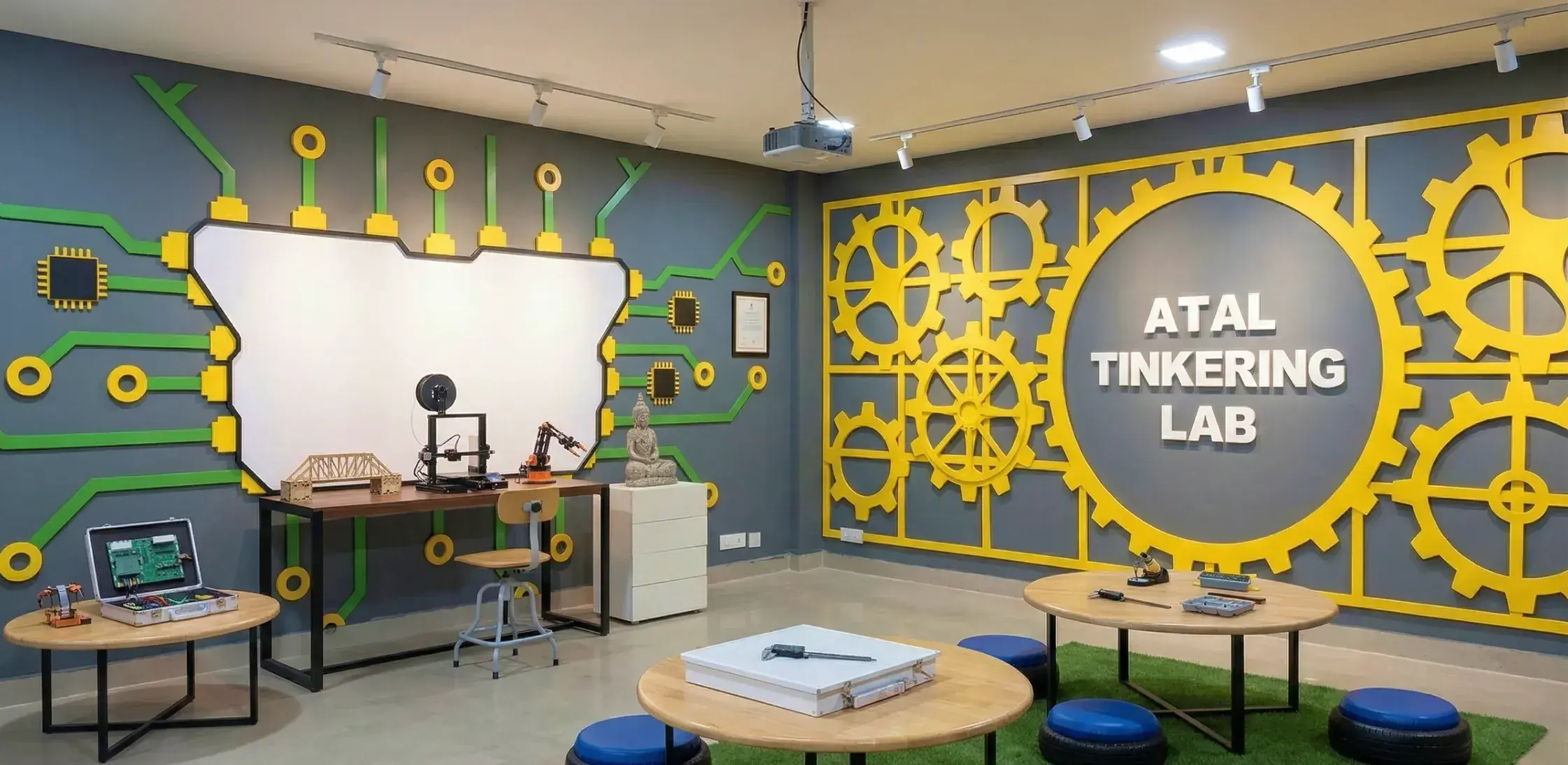
School-based Atal Tinkering Labs were set up as part of the Atal Innovation Mission (AIM) by NITI Aayog to encourage students to try new things and come up with new ideas. Students learn practical problem-solving through hands-on experimentation and project-based learning.
Atal Tinkering Labs are built around the concept of learning by doing. In addition to learning theories, students use modern tools and technologies to work on real projects.
These labs usually have learning areas and tools like:
- Robotics and automation tools
- AI and IoT learning kits
- Electronics and sensor modules
- Coding and programming platforms
- 3D printing and prototyping tools
- STEM experimentation kits
Starting an Atal making lab is meant to encourage students to be innovative, creative, and entrepreneurial from a young age.
Aim of Atal Tinkering Lab
The aim is to create future innovators and problem solvers by building innovation-focused learning environments in schools.
The main goals are the following:
- Promote hands-on STEM learning
- Develop creativity and problem-solving skills
- Introduce students to emerging technologies
- Encourage teamwork and entrepreneurial thinking
To make schools more ready for the future, adding this lab is a big step forward.
Why Atal Tinkering Labs are Important in Schools
Traditional classroom learning often lacks practical application and experimentation.
A successful Atal Tinkering Lab helps schools.
- Encourage learning by doing.
- Promote experiential learning
- Increase student participation
- Improve invention and creativity
- Promoting teamwork and working together
- Increase your scientific and analytical knowledge
- Using project-based learning to boost your confidence
- Preparing students for future careers and emerging industries
Students working in an Atal Tinkering Lab gain hands-on experience that helps them understand concepts more effectively than classroom-only learning.
Atal Tinkering Lab Requirements
Schools need to know the basic requirements for an Atal Tinkering Lab before they can start setting it up.
1. Dedicated Space
Schools need a room with good ventilation and enough space for students to work together to learn and try new things.
Recommended Features:
- At least 1,000 to 1,500 square feet of space
- Having enough light and air flow
- Different ways to arrange the seats
- Set up of safe electricity
2. Basic Infrastructure
What should be in the lab:
- A steady flow of electricity
- Fast link to the internet
- Desks and workstations
- Cabinets for storage
- Whiteboards and places to show things
3. ATL Equipment and Tools
A successful Atal Tinkering Lab setup requires modern equipment, such as:
Electronics & Computing
- Arduino and Raspberry Pi kits
- Sensors and electronic components
- Coding software and AI platforms
Robotics & Prototyping
- Robotics starter kits
- 3D printers
- Automation tools
- DIY prototyping equipment
Safety & Infrastructure
- Fire extinguishers
- First-aid kits
- Electrical safety systems
4. Skilled Mentors and Teachers
For the Atal Tinkering Lab to work in schools, teachers are very important.
Schools should provide:
- Classes for training
- Technical skill-building sessions
- Mentorship schemes for innovation
5. Innovation-Focused Curriculum
Schools should integrate ATL activities into academics through:
- STEM projects
- Innovation challenges
- Hackathons
- Robotics competitions
Atal Tinkering Lab Model
A well-designed school innovation lab model ensures maximum student engagement and effective learning.
Innovation Zone
A brainstorming area where students discuss ideas and design solutions.
Electronics Zone
Used for:
- Circuit building
- Sensor experiments
- Electronic prototyping
Robotics and Coding Zone
Dedicated to:
- Robotics projects
- Automation systems
- Coding activities
Prototyping Zone
Includes:
- 3D printing
- Model development
- Product design
Presentation Zone
A collaborative area for:
- Team discussions
- Project showcases
- Innovation presentations
A structured school innovation lab model creates an organised and productive learning environment.
How to Set Up Atal Tinkering Lab?
“How do I set up Atal tinkering lab?” is a common question in schools. A detailed procedure for a successful implementation is provided below.
Step 1: Assess School Readiness
Before starting the Atal Tinkering Lab setup, evaluate:
- Available infrastructure
- Space requirements
- Technical resources
- Budget availability
- Teacher readiness
This helps schools identify gaps and plan effectively.
Step 2: Define Goals and Vision
Schools should clearly define:
- Learning objectives
- Student participation plans
- Modern learning goals
- STEM integration strategies
A clear vision improves long-term success.
Step 3: Plan the Budget
Budget planning is one of the most important parts of the school innovation lab setup.
Typical Budget Areas:
- Infrastructure setup
- Furniture and interiors
- Lab equipment
- Software tools
- Teacher training
- Maintenance costs
Schools should also allocate funds for future upgrades.
Step 4: Design the Lab Layout
An effective lab layout should be:
- Student-friendly
- Flexible
- Collaborative
- Technology-enabled
The space should encourage creativity and experimentation.
Step 5: Procure ATL Equipment
Purchase tools that align with official guidelines and student learning goals.
Important Considerations:
- Quality equipment
- Safety compliance
- Easy maintenance
- Scalable technology
Step 6: Install Technology and Safety Systems
Schools must ensure:
- Proper electrical installation
- Safe wiring systems
- Internet connectivity
- Security and surveillance
- Emergency safety equipment
Step 7: Train Teachers and Mentors
Teacher training is critical for a successful school innovation lab in schools.
Training should include:
- Robotics basics
- Coding skills
- AI and IoT exposure
- Design thinking methodologies
- Modern learning mentoring
Step 8: Launch Student Innovation Programs
To maximise engagement, schools should organise:
- Lab workshops
- Creative fairs
- Robotics competitions
- STEM exhibitions
- Hackathons
- Prototype showcases
These activities encourage active participation.
Step 9: Integrate ATL with School Curriculum
Schools should connect projects with classroom subjects such as:
- Science
- Mathematics
- Computer applications
- Engineering concepts
This improves practical understanding.
Step 10: Monitor and Upgrade the Lab
A school innovation lab should continuously evolve.
Schools should:
- Track student participation
- Evaluate project outcomes
- Upgrade technology regularly
- Maintain equipment periodically
Continuous improvement ensures sustainability.
The Official Atal Tinkering Lab Setup Process
Schools considering an Atal Tinkering Lab should comprehend the NITI Aayog Atal Practical Learning Mission (AIM) application and approval process. Correct implementation, funding, and lab success are guaranteed by following the protocol.
1. Check School Eligibility
Before applying, schools must meet Atal Innovation Mission eligibility requirements. Most schools with grades VI–XII (or equivalent secondary and higher secondary levels) can apply for an ATL.
Schools should also evaluate:
- Dedicated lab space
- Basic infrastructure readiness
- Supporting STEM and modern learning-led learning
- Available teachers or mentors for lab activities
Understanding eligibility helps schools write better applications.
2. AIM Portal registration
Registering the school on the Atal Innovation Mission (AIM) portal is next. Schools must submit institutional, contact, infrastructural, and other information upon registration.
AIM is the official platform for:
- The ATL applications
- News and updates
- Application tracking
- Updates on funding and execution
School registration information should be precise and current.
3. Apply for ATL
The School Innovation Lab application must be completed by schools after registration.
The application usually includes:
- School profile and infrastructure
- ATL implementation goals
- Practical learning, STEM education plans
- Ideas for student engagement
- Teaching and mentoring plans
A strong vision paper enhances the application and shows the school’s dedication to innovation-driven education.
4. The Selection and Evaluation Process
The Atal Innovation Mission analyses school designs on numerous criteria:
Infrastructure prep
- Leadership commitment to the school
- Possible impact on education
- Sustainable long-term plans
AIM notifies chosen universities of ATL permission.
5. Signing the ATL Agreement
The Atal Innovation Mission requires the school to sign an agreement after selection. This agreement cements the institution-AIM relationship for lab setup and operation.
The agreement usually states:
- School obligations
- Use of funds
- Guidelines for operations
- Reporting and monitoring needs
This stage starts the lab setup.
6. Funding and Infrastructure
After the agreement, AIM funds the Atal Tinkering Lab. Funds are mostly utilised for:
- Setting up the ATL infrastructure
- STEM kits and inventive-thinking equipment purchase
- Automation and electronics
- 3D printing/prototyping
- Computers, software
- Utility and safety requirements
Schools can then build a fully functional inventive thinking centre that meets ATL and student learning objectives.
7. Lab Setup, Training, Implementation
After obtaining financing, schools implement:
Setting up ATL
- Lab and workplace arrangement
- Mentor and teacher training
- student orientation sessions
- STEM/Tech-enabled education workshops
- The school Innovation Lab fosters invention, experimentation, and problem-solving with adequate preparation.
8. Constant Inventive Thinking and Student Engagement
Unlike a lab, an ATL is a school’s collaborative STEM environment. Long-term success requires schools to:
- Inventive thinking problems
- Robotics contests
- Code workshops
- STEM displays
- Hackathons
- Prototype showcases
Student involvement and coaching maximise Atal Tinkering Lab’s impact.
Common Challenges in Atal Tinkering Lab Setup
When schools set up an ATL, they might run into a few problems.
- Limited Funding: The prices of buildings and tools are a problem for many schools.
- Lack of Skilled Educators: It’s possible that teachers need more technical training.
- Equipment Maintenance Issues: Regular maintenance and changes are needed for lab tools.
- Low student participation: If students aren’t given the right tasks to do, their participation may drop.
- Problems integrating the curriculum: In some places, it’s hard to connect ATL with academics.
Seeing these problems early on helps schools come up with better ways to apply them.
How Schools Can Overcome ATL Challenges
Schools can strengthen their school innovation lab through the following strategies.
Regular Teacher Training
Continuous upskilling helps teachers guide tech-enabled education projects effectively.
Industry Collaboration
Schools can partner with:
- Technology companies
- Skill-based learning mentors
- Startup ecosystems
- STEM organizations
Student Engagement Programs
Activities such as:
- Hackathons
- Competitions
- STEM clubs
- Exhibitions
Keep students motivated.
Routine Equipment Maintenance
Regular servicing improves the school’s innovation lab’s sustainability and safety.
Community and Parent Participation
Parental support and community involvement increase awareness and participation.
How Shikshak Solutions Helps Schools Set Up Atal Tinkering Labs
Schools may find it hard to set up an ATL because they have to plan the infrastructure, choose the technology, train staff, and deal with problems that come up during the process. Shikshak Solutions helps organisations build whole creative communities in this area.
Shikshak Solutions helps schools set up Atal Tinkering Lab from start to finish.
Our services include:
Planning & consulting, and full setup of the ATL infrastructure
To create a unique lab roadmap, we assess your school’s infrastructure, academic goals, and student needs. We help schools plan and set up fully functional lab spaces, ensuring they are properly designed and implemented.
Buying Equipment
Our high-quality ATL tools include the following:
- Sets for robots
- Kits for Arduino and Raspberry Pi
- AI and IoT tools
- 3D printers
- STEM kits for new ideas
- Systems for electronics and automation
Teacher Training Programs
Our training classes, led by experts, give teachers the confidence to run ATL projects and new ideas.
Help with the ATL curriculum and activities
We help schools organise:
- Skill-based learning programs
- STEM workshops
- Hackathons
- Robotics competitions
- Coding activities
- Student project development
Ongoing Technical and Maintenance Support
Shikshak Solutions makes sure that schools always have access to technical support, advice on how to keep tools in good shape, and help with ATL upgrades.
Why Choose Shikshak Solutions for ATL Setup?
Schools choose Shikshak Solutions because we focus on:
- Customized ATL solutions
- Future-ready technology integration
- Practical learning models
- Teacher empowerment
- Student Skill-based learning development
- End-to-end School innovation lab execution support
Our goal is to help schools create an impactful school innovation lab that inspires skill-based learning, creativity, and future-ready learning.
FAQs – Atal Thinkring Lab
1. What is the process of setting up an ATL?
The procedure consists of:
- Infrastructure evaluation
- Planning for ATL
- Design of a lab
- Purchasing equipment
- Setting up
- Training for teachers
- Launch of the student program
- Ongoing upkeep and improvements
2. How much time does it take to complete an ATL setup?
The school’s infrastructure and needs determine the timeline. It usually takes a few weeks to many months to build up a lab.
3. Can schools customise their Atal Tinkering Lab model?
Indeed, based on student strengths, available space, and instructional objectives, schools can design a customised ATL model.
4. Why is teacher training important in ATL implementation?
STEM education, robotics projects, coding sessions, and innovation activities are all supervised by teachers. Effective ATL management is ensured by appropriate training.
5. How can Shikshak Solutions help in setting up an ATL?
Shikshak Solutions offers schools comprehensive lab advice, infrastructure setup, equipment purchases, teacher training, curriculum support, and continuing maintenance support.