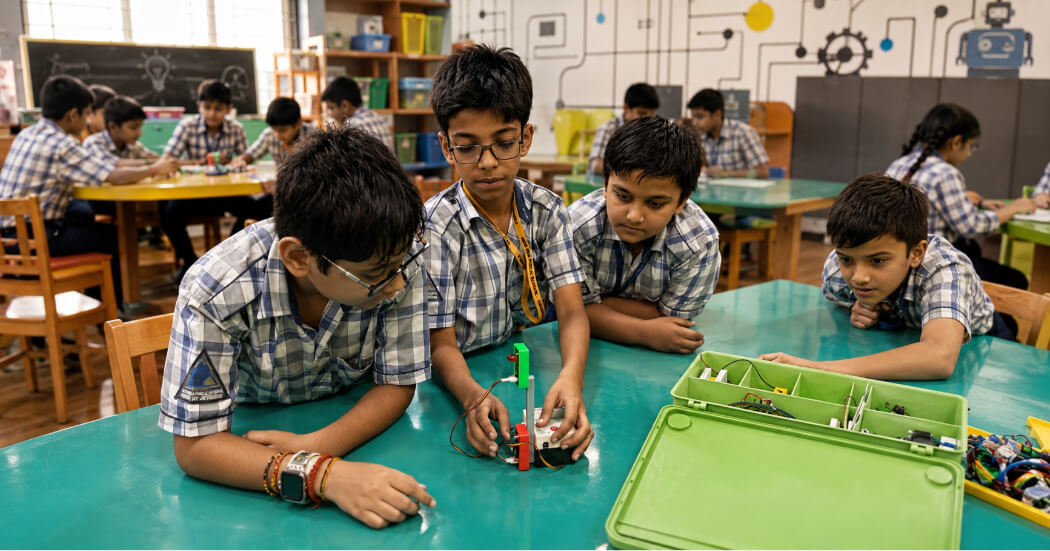
Beyond the Blackboard: How Teachers Are Getting Hands-On With Learning
A classroom has changed considerably over the years.
The blackboard is still here. Textbooks are not dead yet. Teachers continue to explain concepts, assign assignments and prepare pupils for exams. But beyond these classic methods, something essential is happening in classrooms today: learning is becoming more active, more practical and more connected to the world beyond school.
Perhaps a lesson on electricity will no longer end with a diagram in a notepad. Students can design a simple circuit and see what happens when the connection is modified.
A science class might start with a definition from a book, then an experiment where students make observations, write down their results and discuss why this happened.
Students find the maths subject easier when they observe a real-life scenario.
The lesson on technology becomes significant when students develop, code, test and improve something of their own.
This is the growth of experiential learning, and teachers are at the heart of it.
This Teacher’s Day Week, as we celebrate educators and everything they accomplish in the classroom, it’s important to go beyond the lesson plan and acknowledge the effort behind these experiences. Because an interesting classroom doesn’t just happen. It is made by teachers who are always thinking about how their pupils might grasp, experience, and retain what they are learning.
From Listening to Learning by Doing
For many years, classroom learning was closely associated with listening to the teacher, reading the textbook, taking notes and preparing for examinations.
There is still merit in these approaches. Students require concepts, explanations and background to help them. But information is more important when pupils have a chance to use it.
Here is where the importance of experiential learning comes in.
Rather than explaining to children how a pulley works, a teacher may provide supplies and have them build a pulley.
Rather than simply looking at diagrams that describe the basic principles of robotics, students are able to build a robot, wire the parts, and see their commands make it go.
Instead of just talking about environmental challenges, students should be asked to build a solution to save water, reduce trash, or monitor air quality.
The teacher continues with the idea. But the difference is pupils are not just getting knowledge anymore. They’re dealing with this.
Research and educational practice are increasingly emphasising this form of active, inquiry-driven learning, where students ask questions, study ideas, work through issues and develop their own understanding.
The Teacher Is Still the Most Important Tool in the Classroom
With smart boards, instructional applications, films, AI tools, STEM kits and digital resources becoming more widespread, it can often feel as if technology is driving the shift in education.
But technology alone doesn’t make meaningful learning.
The teacher determines how it is used.
An unopened robotics kit in a classroom does not teach a youngster robotics.
Playing a video on a screen does not necessarily generate curiosity.
AI tools do not automatically make a pupil think critically.
The teacher is the one who asks:
- What do you think is going to happen.
- ”What do you think that was for?
- “Is there an alternative approach?
- If you created it again, what would you change?”
These questions convert a demonstration into an inquiry and an activity into a learning experience.
The research on STEM education additionally emphasises the shifting role of teachers. Modern STEM educators need subject expertise, communication skills, creativity, cooperation, understanding of technology and the ability to connect classroom topics to real-world situations.
The teacher is no longer the information-giver at the front of the classroom.
The teacher is becoming a facilitator, mentor, advisor, and learning designer.
When a Science Lesson Becomes an Experiment
Think about a teacher who introduces wind energy.
One way is to explain wind turbines, display a picture, and ask the students to recall the definition.
You may also ask:
“How do we make energy from moving air?”
The classroom is now changing.
Students start talking about concepts. They build miniature models. They try out several designs. Some models do work. Others don’t. Students compare achievements and improve.
In a flash, the lecture incorporates science, engineering, measurement, creativity, teamwork, and problem solving.
That’s the magic of hands-on STEM learning.
The students are learning more than just a concept. They are learning what it is like to research a subject.
As Science Outside puts it, compelling science teaching may take students beyond memorising knowledge to exploring, experimenting, storytelling and doing real science.
And behind that experience is a teacher who has planned for the activity, acquired the resources, anticipated the problems and thought about how to link the activity back to the learning aim.
Curiosity Often Starts With One Simple Question
Children naturally ask questions.
- Why does this happen?
- What happens if I change this?
- Why is the bird flying?
- Can this robot move faster?
- What happens when I add more weight?
- What if we try it differently?
These questions are not distractions from learning. They can be the beginning of learning.
Teachers who encourage students to ask questions create opportunities for deeper understanding.
Instead of immediately giving students the correct answer, a teacher may sometimes respond with another question:
- “What do you think?”
- “How could we find out?”
- “What evidence do you have?”
- “Can you test your idea?”
This small change can encourage students to become active participants in the learning process.
The Van Andel Institute for Education similarly highlights curiosity, student choice, and opportunities for students to construct their own understanding as important ways of creating more experiential and inquiry-driven classrooms.
Learning Through Trial, Error and Try Again
Hands-on learning may teach kids some of the most important things that can’t always be found in a textbook:
- That’s okay; it doesn’t have to work the first time.
- The robot may not move.
- The circuit may not light up.
- A bridge fashioned out of craft sticks might collapse.
- The model might not work as planned.
- The first solution by a student may not solve the problem.
And that’s where the true learning can start.
The teacher can have the kids look at what happened, find the fault, make an adjustment, and try again.
This method creates something much more powerful than the ability to do one activity in the classroom. This increases resilience, critical thinking and problem-solving skills.
Research on teaching STEM also stresses the significance of creativity, critical thinking, cooperation and problem solving, with teachers establishing spaces in which students may explore ideas and learn through the process, rather than focusing simply on the end answer.
In a real classroom, a bad experiment is not always an unsuccessful lesson.
Sometimes it is the most successful aspect of the lesson.
From “What Is the Answer?” to “How Did You Find It?”
Traditional assessment tends to be about whether the student has the right response.
Hands-on learning might prompt teachers to look more closely.
How did the student tackle the problem?
What did they see?
Why that solution?”
What was different the second time around?”
What did they take from the mistake?
Can they tell someone else what they are thinking?
These are questions that important because education is about more than just getting the right answers. It’s also about building the capacity to think, reason, communicate and make decisions.
For example, a STEM project provides teachers an opportunity to see these skills in action.
A student who cannot explain a textbook definition might confidently show that same notion with a model they have constructed themselves.
Another student who often sits quietly in lectures can end up being the head of a group effort.
The classroom may teach a youngster who is frightened of making mistakes that improvement is more important than perfection, so they can slowly grow comfortable trying out an idea.
This is where experiential learning is so much more than an activity.
It’s a tool for teachers to find out how their students learn.
Technology Can Enhance Learning When Teachers Give It Purpose
Today’s classrooms have access to more technology than ever before.
Videos can demonstrate processes that are difficult to observe in a classroom. Simulations can help students explore situations that may be difficult or unsafe to reproduce. Sensors can help students collect real-world data. Coding platforms can turn instructions into interactive projects. AI and digital tools can open new possibilities for exploration.
But good teaching is not about using technology simply because it is available.
The purpose should always come first.
A digital tool is valuable when it helps students observe, investigate, create, analyse or solve something.
For example, a sensor can help students collect temperature data instead of simply reading about temperature. A coding platform can allow students to see how an instruction changes the behaviour of a system. An AI camera can turn a discussion about computer vision into something students can actually explore.
The technology becomes meaningful because the teacher connects it to a learning objective.
This is why the role of the teacher remains so important even as technology becomes more sophisticated.
The Teacher Who Makes Learning Personal
Every classroom has students who learn differently.
- Some understand a concept immediately.
- Some need another explanation.
- Some learn best by seeing.
- Some by listening.
- Some by building.
- Some need to try something several times before the idea finally clicks.
A thoughtful teacher notices these differences.
They explain the same concept in another way. They draw another diagram. They show a video. They give an example. They demonstrate an experiment. They ask the student to try it. They come back to the idea later.
And sometimes, they explain it all over again.
That repetition is something students may never notice.
They may remember the activity, the experiment, the project, or the fun moment in class. But behind that moment may be a teacher who revised the explanation multiple times, changed the approach, and patiently tried again because they wanted every student to have a fair chance to understand.
That is one of the quietest and most important parts of teaching.
Hands-On Learning Takes More Than a Kit
It is easy to look at a STEM classroom and notice the visible things: a robotics kit, a model, a science experiment, a computer, or a smart board.
But the most important part of the experience is not the equipment.
It is the teacher’s planning and intention.
A teacher has to decide:
- What should students learn from this activity?
- What materials will they need?
- How can the activity be made age-appropriate?
- What questions should be asked?
- What could go wrong?
- How can every student participate?
- How should students reflect on what they have learned?
- How can the activity connect back to the curriculum?
This preparation often happens long before students enter the classroom.
That is why hands-on education should not be mistaken for simply “letting children play with things.”
When thoughtfully designed, it is learning through doing with a clear educational purpose.
Teachers Are Creating Experiences, Not Just Lessons
The best classroom memories are often not the definitions students memorised.
- They are the moments they remember experiencing.
- The first time a bulb lit up.
- The robot finally moved.
- The volcano model erupted.
- The bridge they built actually held weight.
- The experiment produced an unexpected result.
- The group solved a problem after several failed attempts.
The teacher looked at their project and said, “Let’s see what happens if you try it this way.”
These moments stay with students because they connect knowledge with experience.
And this is perhaps what makes hands-on teaching so powerful.
It gives students a reason to remember what they learned.
Behind Every Engaging Classroom Is a Teacher Who Keeps Trying
As we observe Teacher’s Day Week, it’s simple to talk about innovation, technology, STEM labs and modern classrooms.
But we should also just pause and recognise the person who makes all of this happen.
- The teacher who prepares for class.
- The teacher who explains a difficult topic in three distinct ways.
- The teacher who can tell when a student is in trouble.
- The instructor who lifts up the child who says, “I can’t do this.”
- The teacher that advises, ‘Try it one more time.’
- The teacher who turns a chapter into an action.
- The teacher who makes an inquiry of a question.
- The instructor who makes a lesson mistake.
And the instructor who can explain the same topic over and over again, reworking the explanation, and patiently starting all over, not because the lesson is easy, but because the student deserves another chance to grasp.
That effort is seldom seen on a report card.
But it can hang on for years with a child.
Beyond the Blackboard
Hands-on learning does not mean leaving the blackboard behind.
It means expanding what can happen after the explanation.
Explain it. Show it. Let students try it. Let them question it. Let them improve it.
That is where learning becomes an experience.
Today’s teachers are helping students move from memorising to understanding, from listening to participating, and from asking for answers to learning how to find them.
And while technology, STEM tools and innovative teaching methods may change the classroom, one thing remains constant:
A teacher who cares enough to keep trying can change the way a child sees learning.
This Teacher’s Day Week, let’s celebrate not only the lessons teachers teach, but also the patience, preparation, creativity and perseverance behind every lesson.
Beyond the blackboard, beyond the textbook and beyond the classroom, teachers are helping children discover something much bigger:
‘The confidence to learn, the courage to experiment and the belief that they can create something of their own.’