Table of Contents
Artificial Intelligence is no longer something that students learn about in textbooks. AI is now a part of daily life, from voice assistants and recommendation systems to visual recognition and chatbots.
For students, the best approach to learning AI is to work with it.
With an AI project, students get to go beyond definitions and see how data, algorithms, and technology can be applied to a problem. It also helps teachers to make AI principles a reality in practical classroom learning and gives students something to show at a science expo, school project, competition or portfolio.
Current collections of AI projects include domains such as machine learning, computer vision, natural language processing, deep learning, and generative AI.
What Are AI Projects for Students?
AI projects for students are hands-on activities in which learners employ artificial intelligence concepts or tools to build a workable model, application, prediction system, or solution.
Projects can range from teaching a computer to recognize photographs or sort communications to building an AI-powered chatbot or an object-detection system.
The purpose isn’t just to build something that looks good.
The idea is to get a feel for how AI works and how it may be utilized to solve a genuine problem.
Why Should Students Build AI Projects In School?
It can be much easier to understand abstract notions when learning AI with projects.
When a student does a project, they get to:
- Work with real/sample data
- How AI models predict
- Give it a go with other inputs
- Check their model is working
- Identify faults and enhance the output
- AI connected to real-world challenges
- Learn coding and problem-solving skills
- Present and explain their work with confidence
A student can also put a finished project in their portfolio. For older students, putting well-documented work on sites like GitHub can show practical skills beyond just diplomas.
Artificial Intelligence Project Ideas for Students
The age of the learner, their previous knowledge, the tools available, and the amount of time available all determine the suitable AI project. Here are some suggestions from basic to more complex tasks.
1. AI Image Classifier
Build a simple system to identify distinct objects or categories from photos.
For example, students may train a model to differentiate between various sorts of recyclable material, animals, or daily items.
Students learn: Image classification, training data, computer vision, and model testing.
2. Face Detection System
Build a face detection program utilizing camera.
This is a good introduction to computer vision since students may observe the way that artificial intelligence systems interpret visual input.
Students learn: Computer vision, image processing, and object detection.
3. Hand Gesture Recognition
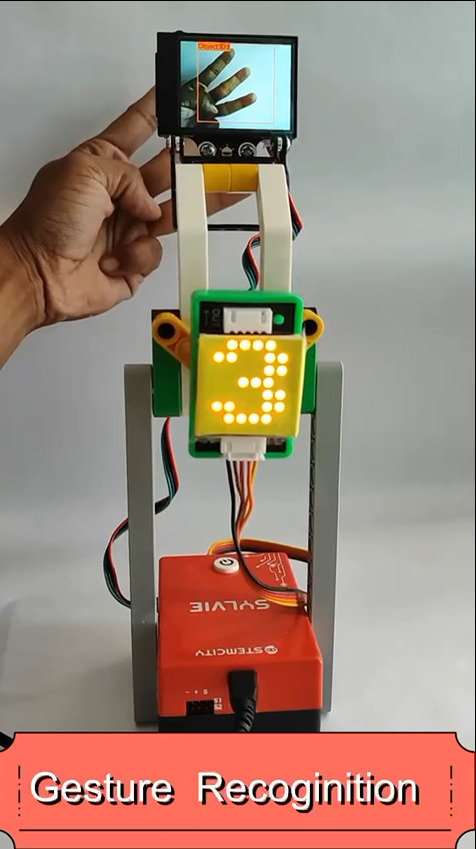
Train an AI system to identify simple hand motions.
Students could utilize gestures as commands, for example, recognizing different hand positions to control an application or robot.
Students learn: Visual recognition, computer vision, and human-computer interface.
4. AI Chatbot
Build a basic chatbot that can respond to questions on a certain subject, such as a school, subject, science display, or fictitious character.
A simple chatbot can have canned answers. More sophisticated chatbots can use natural language processing or contemporary AI models.
Students learn: natural language processing, conversation design, and applications of AI.
5. Sentiment Analysis
Build a system that analyses text and identifies whether the sentiment is positive, negative, or neutral.
Students could test the model using reviews, comments or sample sentences.
Students learn: Natural language processing, text classification and data analysis.
6. Email Spam Detector
Create a machine learning model that classifies messages as spam or not spam.
This is a practical way to introduce students to classification and the importance of training data.
Students learn: Machine learning, text classification, and data preparation.
Spam detection is also represented among current open-source AI project examples on GitHub.
7. Handwritten Digit Recognition
Train an AI model to recognise handwritten numbers.
This classic project introduces students to image classification and neural networks without requiring an overly complicated real-world application.
Students learn: Machine learning, neural networks, image processing and model accuracy.
8. Object Detection System
Build an AI application that identifies objects through an image or camera.
For example, a student could create a system that recognises bottles, books, people or other selected objects.
Object detection, computer vision and camera-based AI projects are among the types of projects currently represented in open-source AI repositories.
Students learn: Computer vision, object detection and real-time AI.
9. AI-Based Plant Disease Detection
Students can create a system that analyses images of plant leaves and attempts to identify specific disease categories.
This project connects AI with agriculture and environmental problem-solving.
Students learn: Image classification, datasets, computer vision, and practical AI applications.
10. Movie Recommendation System
Create a basic recommendation system that suggests movies based on a user’s interests or previous choices.
This helps students understand how recommendation systems can use information about users and items to generate suggestions.
Students learn: Data analysis, machine learning, and recommendation systems.
11. Student Performance Prediction
Students can explore how machine learning models use data to identify patterns and make predictions.
For example, a model could analyse sample academic data and predict performance based on selected factors.
Similar student-performance prediction projects are available in current AI repositories.
Students learn: Data handling, classification or regression, prediction, and responsible use of data.
12. AI-Powered Voice Assistant
Create a simple voice-based application that can recognise spoken commands and respond to them.
Students can start with a limited set of commands and gradually make the system more capable.
Students learn: Speech recognition, natural language processing, and human-computer interaction.
13. AI Object-Sorting System
Combine computer vision with a physical system to identify and sort objects.
For example, students could create a prototype that identifies different categories of waste and directs them into separate sections.
Students learn: AI, computer vision, sensors, automation, and robotics.
This type of project is particularly useful for STEM classrooms because it connects software-based AI with physical problem-solving.
14. AI-Powered Question Answering System
Create a system that can answer questions from a selected collection of information, such as school rules, a science topic, or a set of study materials.
More advanced implementations can introduce students to retrieval-augmented generation (RAG), an approach represented in current open-source AI projects.
Students learn: Natural language processing, information retrieval, and generative AI.
15. AI for Environmental Monitoring
Students can explore how AI can help identify or predict environmental conditions.
Depending on their level, they could work with data related to air quality, weather, water usage or waste management.
Students learn: Data analysis, machine learning, environmental science and responsible technology use.
AI Projects for Different Student Levels
Not every student needs to begin with Python, neural networks, or advanced machine learning.
For Beginners
Start with projects such as:
- Image classification
- Simple chatbot
- Handwritten digit recognition
- Sentiment analysis
- Spam detection
- Basic recommendation system
These projects help students understand the basic AI workflow without overwhelming them.
For Intermediate Students
Students with some programming experience can explore:
- Object detection
- Plant disease detection
- Voice assistants
- Student performance prediction
- Advanced recommendation systems
- AI-powered applications
For Advanced Students
Students who already understand programming and machine learning can explore:
- RAG-based question-answering systems
- AI agents
- Deep learning applications
- Advanced computer vision
- Large language model applications
- AI integrated with IoT or robotics
Current AI project collections show this broad progression from beginner machine-learning applications to computer vision, NLP, generative AI, RAG, and LLM-based projects.
How to Choose the Right AI Project
The most complicated project isn’t necessarily the best one.
Before choosing an AI project for students, ask:
Is it suitable for the student’s level?
A project should challenge the student without becoming impossible to understand.
Does it solve a problem?
Projects become more meaningful when students can explain why their solution is useful.
Can the student explain how it works?
A student should understand the basic idea behind the data, model, inputs, and outputs rather than simply presenting something created by someone else.
Can it be tested?
A good AI project should give students opportunities to test the system, identify mistakes and improve it.
Can it be demonstrated?
A working demonstration can make an AI project much more engaging during a school exhibition or presentation.
What Students Should Learn From an AI Project
The final model is only one part of the learning.
Students should understand the basic journey:
Problem → Data → Training → Testing → Prediction → Improvement
They should be able to explain what problem they were trying to solve, what information the AI system used, how it produced an output, and what could be improved.
This is more valuable than simply presenting a project with a lot of technical terminology.
AI Projects Should Also Teach Responsible AI
As students begin working with AI, they should learn that building an AI system is not only about making predictions.
They should also think about:
- Where did the data come from?
- Is the data reliable?
- Could the model be biased?
- Is personal information being used?
- Can the result be trusted?
- What happens if the AI makes a mistake?
These questions help students understand that responsible AI is part of learning AI.
From AI Theory to Practical Learning
AI can seem complicated when students encounter only terms such as machine learning, neural networks, computer vision, and natural language processing.
Projects make those ideas tangible.
A student who builds an image classifier can see what training data does. A student creating a chatbot can explore how computers process language. A student working on object detection can understand how AI interprets images.
That is why AI projects can be a valuable part of modern STEM and computer education.
Final Thoughts
The best artificial intelligence projects for students are not necessarily the ones with the most advanced technology.
They are the ones that encourage students to ask a question, explore an idea, build something, test it, and understand what they have created.
Whether it is a simple image classifier for a beginner or an AI-powered application for an advanced learner, every project can be a starting point for deeper learning.
For teachers and schools, the focus should be on creating opportunities for students to move from “I know what AI is” to:
“I understand how AI works, and I can use it to solve a problem.”
That is where AI education becomes practical, engaging, and future-ready.
Complete AI solutions by Shikshak Solutions AI lab.